

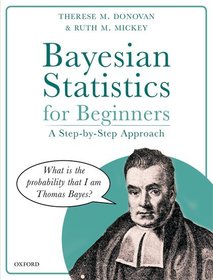
Bayesian Statistics for Beginners
a step-by-step approach
- Publisher's listprice GBP 112.50
-
53 746 Ft (51 187 Ft + 5% VAT)
The price is estimated because at the time of ordering we do not know what conversion rates will apply to HUF / product currency when the book arrives. In case HUF is weaker, the price increases slightly, in case HUF is stronger, the price goes lower slightly.
- Discount 10% (cc. 5 375 Ft off)
- Discounted price 48 372 Ft (46 068 Ft + 5% VAT)
Subcribe now and take benefit of a favourable price.
Subscribe
53 746 Ft

Availability
printed on demand
Why don't you give exact delivery time?
Delivery time is estimated on our previous experiences. We give estimations only, because we order from outside Hungary, and the delivery time mainly depends on how quickly the publisher supplies the book. Faster or slower deliveries both happen, but we do our best to supply as quickly as possible.
Product details:
- Publisher OUP Oxford
- Date of Publication 29 May 2019
- ISBN 9780198841296
- Binding Hardback
- No. of pages430 pages
- Size 247x193x26 mm
- Weight 1038 g
- Language English 0
Categories
Short description:
This is an entry-level book on Bayesian statistics written in a casual, and conversational tone. The authors walk a reader through many sample problems step-by-step to provide those with little background in math or statistics with the vocabulary, notation, and understanding of the calculations used in many Bayesian problems.
MoreLong description:
Bayesian statistics is currently undergoing something of a renaissance. At its heart is a method of statistical inference in which Bayes' theorem is used to update the probability for a hypothesis as more evidence or information becomes available. It is an approach that is ideally suited to making initial assessments based on incomplete or imperfect information; as that information is gathered and disseminated, the Bayesian approach corrects or replaces the assumptions and alters its decision-making accordingly to generate a new set of probabilities. As new data/evidence becomes available the probability for a particular hypothesis can therefore be steadily refined and revised. It is very well-suited to the scientific method in general and is widely used across the social, biological, medical, and physical sciences. Key to this book's novel and informal perspective is its unique pedagogy, a question and answer approach that utilizes accessible language, humor, plentiful illustrations, and frequent reference to on-line resources.
Bayesian Statistics for Beginners is an introductory textbook suitable for senior undergraduate and graduate students, professional researchers, and practitioners seeking to improve their understanding of the Bayesian statistical techniques they routinely use for data analysis in the life and medical sciences, psychology, public health, business, and other fields.
While reading this book, I joined the authors on a learning endeavor thanks to their honesty and intellectual vulnerability. Their lack of experience with Bayesian statistics helps them to be effective communicators . . . If you are interested in starting your Bayesian journey, then Bayesian Statistics for Beginners is an excellent place to begin.
Table of Contents:
Section 1
Basics of Probability
Introduction to Probability
Joint, Marginal, and Conditional Probability
Section 2
Bayes' Theorem and Bayesian Inference
Bayes' Theorem
Bayesian Inference
The Author Problem - Bayesian Inference with Two Hypotheses
The Birthday Problem: Bayesian Inference with Multiple Discrete Hypotheses
The Portrait Problem: Bayesian Inference with Joint Likelihood
Section 3
Probability Functions
Probability Mass Functions
Probability Density Functions
Section 4
Bayesian Conjugates
The White House Problem: The Beta-Binomial Conjugate
The Shark Attack Problem: The Gamma-Poisson Conjugate
The Maple Syrup Problem: The Normal-Normal Conjugate
Section 5
Markov Chain Monte Carlo
The Shark Attack Problem Revisited: MCMC with the Metropolis Algorithm
MCMC Diagnostic Approaches
The White House Problem Revisited: MCMC with the Metropolis-Hastings Algorithm
The Maple Syrup Problem Revisited: MCMC with Gibbs Sampling
Section 6
Applications
The Survivor Problem: Simple Linear Regression with MCMC
The Survivor Problem Continued: Introduction to Bayesian Model Selection
The Lorax Problem: Introduction to Bayesian Networks
The Once-ler Problem: Introduction to Decision Trees
Appendices
Appendix 1: The Beta-Binomial Conjugate Solution
Appendix 2: The Gamma-Poisson Conjugate Solution
Appendix 3: The Normal-Normal Conjugate Solution
Appendix 4: Conjugate Solutions for Simple Linear Regression
Appendix 5: The Standardization of Regression Data

