

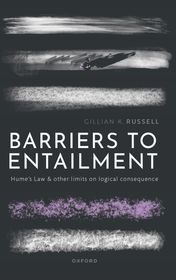
Barriers to Entailment
Hume's Law and other Limits on Logical Consequence
- Publisher's listprice GBP 25.00
-
11 287 Ft (10 750 Ft + 5% VAT)
The price is estimated because at the time of ordering we do not know what conversion rates will apply to HUF / product currency when the book arrives. In case HUF is weaker, the price increases slightly, in case HUF is stronger, the price goes lower slightly.
- Discount 10% (cc. 1 128 Ft off)
- Discounted price 10 159 Ft (9 675 Ft + 5% VAT)
Subcribe now and take benefit of a favourable price.
Subscribe
11 287 Ft

Availability
Estimated delivery time: In stock at the publisher, but not at Prospero's office. Delivery time approx. 3-5 weeks.
Not in stock at Prospero.
Why don't you give exact delivery time?
Delivery time is estimated on our previous experiences. We give estimations only, because we order from outside Hungary, and the delivery time mainly depends on how quickly the publisher supplies the book. Faster or slower deliveries both happen, but we do our best to supply as quickly as possible.
Product details:
- Publisher OUP Oxford
- Date of Publication 22 August 2025
- ISBN 9780198980148
- Binding Paperback
- No. of pages320 pages
- Size 235x155x20 mm
- Weight 497 g
- Language English 614
Categories
Short description:
Barriers to Entailment is a book about the limits of logic and their philosophical implications. Gillian Russell shows how, in each of five domains--universality, time, necessity, context-sensitivity, and normativity-- certain kinds of argument are logically unavailable.
MoreLong description:
A barrier to entailment exists if you can't get conclusions of a certain kind from premises of another. One of the most famous barriers in philosophy is Hume's Law, which says that you can't get normative conclusions from descriptive premises, or in slogan form: you can't get an ought from an is. This barrier is highly controversial, and many famous counterexamples were proposed in the last century. But there are other barriers which function almost as philosophical platitudes: no Universal conclusions from Particular premises, no Future conclusions from premises about the Past, and no claims that attribute Necessity from premises that merely tell us how things happen to be in the Actual world. Barriers to Entailment proposes a unified logical account of five barriers that have played important roles in philosophy, in the process showing how to diagnose proposed counterexamples and arguing that the case for Hume's Law is as strong as that for the platitudinous barriers.
The first two parts of the book employ techniques from formal logic, but present them in an accessible way, suitable for any reader with some background in first-order model theory (of the kind that might be taught in a first class in logic). Gillian Russell introduces tense, modal, indexical, and deontic formal logics, but always avoids unneeded complexity. Each barrier is connected to broader philosophical topics: universality, time, necessity, context-sensitivity, and normativity. Russell brings out under-recognised connections between the domains and lays the groundwork for further work at the intersections.
The last part of the book transposes the formal work to informal barrier theses in the philosophy of language, in the process doing new work on the concept of logical consequence, and providing new responses to proposed informal counterexamples to Hume's Law which employ hard-to-formalise tools from natural language, such as speech acts and thick normative expressions.
Each of these various barrier issues has had its own distinctive flavour, and its own associations and repercussions in the history of philosophy. This makes Barriers, quite aside from its intrinsic interest and its many expository virtues, the perfect way of illustrating to a student whose penchant may be - not just for ethics, as in the Is/Ought case - but equally for metaphysics, epistemology or the philosophy of mind, how useful a formal approach to the conceptual fundamentals of the favoured territory can be. This makes it much more valuable, motivationally, than any dry, purely technical introduction to contemporary logical work could ever be. But students aside, any reader with logical interests will find Barriers to be bristling with imaginative curiosity, resourcefully pursued.
Table of Contents:
Acknowledgements
Introduction
Part One: Getting Started
Survey of counterexamples
Universality
Time
General barrier theorems
Modality
Part 2: Getting complex
Can, should, will
Context-Sensitivity
Normativity
All the barriers
Part 3: Getting Informal
Informal models, informal logic
Informal Barriers
Latex Symbol List
Bibliography
Index

