

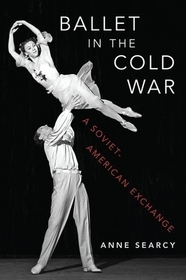
Ballet in the Cold War
A Soviet-American Exchange
- Publisher's listprice GBP 36.99
-
16 700 Ft (15 905 Ft + 5% VAT)
The price is estimated because at the time of ordering we do not know what conversion rates will apply to HUF / product currency when the book arrives. In case HUF is weaker, the price increases slightly, in case HUF is stronger, the price goes lower slightly.
- Discount 10% (cc. 1 670 Ft off)
- Discounted price 15 030 Ft (14 315 Ft + 5% VAT)
Subcribe now and take benefit of a favourable price.
Subscribe
16 700 Ft

Availability
printed on demand
Why don't you give exact delivery time?
Delivery time is estimated on our previous experiences. We give estimations only, because we order from outside Hungary, and the delivery time mainly depends on how quickly the publisher supplies the book. Faster or slower deliveries both happen, but we do our best to supply as quickly as possible.
Product details:
- Publisher OUP USA
- Date of Publication 13 November 2020
- ISBN 9780190945107
- Binding Hardback
- No. of pages198 pages
- Size 239x155x20 mm
- Weight 454 g
- Language English
- Illustrations 16 illus. 37
Categories
Short description:
This book tells the full story of the earliest Soviet-American ballet exchanges, in which the governments of the USSR and the United States sent their most prestigious ballet companies on tours to the other country. Author Anne Searcy draws on Soviet- and American- archival sources and shows the spectacular misunderstandings that happened when audiences trained to view one type of ballet saw a very different style.
MoreLong description:
In 1959, the Bolshoi Ballet arrived in New York for its first ever performances in the United States. The tour was part of the Soviet-American cultural exchange, arranged by the governments of the US and USSR as part of their Cold War strategies. This book explores the first tours of the exchange, by the Bolshoi in 1959 and 1962, by American Ballet Theatre in 1960, and by New York City Ballet in 1962.
The tours opened up space for genuine appreciation of foreign ballet. American fans lined up overnight to buy tickets to the Bolshoi, and Soviet audiences packed massive theaters to see American companies. Political leaders, including Khrushchev and Kennedy, met with the dancers. The audience reaction, screaming and crying, was overwhelming.
But the tours also began a series of deep misunderstandings. American and Soviet audiences did not view ballet in the same way. Each group experienced the other's ballet through the lens of their own aesthetics. Americans loved Soviet dancers but believed that Soviet ballets were old-fashioned and vulgar. Soviet audiences and critics likewise appreciated American technique and innovation but saw American choreography as empty and dry.
Drawing on both Russian- and English-language archival sources, this book demonstrates that the separation between Soviet and American ballet lies less in how the ballets look and sound, and more in the ways that Soviet and American viewers were trained to see and hear. It suggests new ways to understand both Cold War cultural diplomacy and twentieth-century ballet.
Supported by an exacting scholarly apparatus, this is a valuable resource for those interested in dance, choreography, and the history of performance and the arts and diplomacy. Bravissima!
Table of Contents:
Acknowledgements
Note on Transliteration and Translation
Introduction
1. A Cold War Welcome: The Bolshoi Ballet's 1959 Tour of the United States
2. Bringing an American Report Card to Russia: American Ballet Theatre's 1960 Tour of the Soviet Union
3. A Question of Taste: The Bolshoi Ballet's 1962 Tour of the United States
4. "Ballet is a Flower!": New York City Ballet's 1962 Tour of the Soviet Union
Epilogue: Exchange in the Twenty-first Century
Note on Abbreviations
Endnotes
Index

