

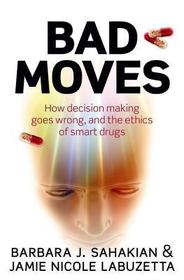
Bad Moves
How decision making goes wrong, and the ethics of smart drugs
- Publisher's listprice GBP 10.99
-
4 961 Ft (4 725 Ft + 5% VAT)
The price is estimated because at the time of ordering we do not know what conversion rates will apply to HUF / product currency when the book arrives. In case HUF is weaker, the price increases slightly, in case HUF is stronger, the price goes lower slightly.
- Discount 10% (cc. 496 Ft off)
- Discounted price 4 465 Ft (4 253 Ft + 5% VAT)
Subcribe now and take benefit of a favourable price.
Subscribe
4 961 Ft

Availability
printed on demand
Why don't you give exact delivery time?
Delivery time is estimated on our previous experiences. We give estimations only, because we order from outside Hungary, and the delivery time mainly depends on how quickly the publisher supplies the book. Faster or slower deliveries both happen, but we do our best to supply as quickly as possible.
Product details:
- Publisher OUP Oxford
- Date of Publication 23 April 2015
- ISBN 9780199668489
- Binding Paperback
- No. of pages180 pages
- Size 196x129x10 mm
- Weight 146 g
- Language English 0
Categories
Short description:
How do our brains make choices? How do factors such as Alzheimer's or depression impair decision-making? Presenting the latest research on 'hot' and 'cold' decision-making, Barbara Sahakian and Jamie Nicole LaBuzetta look at the therapeutic smart drugs now available, and raise concerns about their unregulated use to enhance mental performance.
MoreLong description:
Making decisions is such a regular activity that it is mostly taken for granted. However, damage or abnormality in the areas of the brain involved in decision-making can severely affect personality and the ability to manage even simple tasks.
Here, Barbara Sahakian and Jamie Nicole LaBuzetta discuss the process of normal decision making - our strategies for making decisions, biases that affect us, and influential factors - and then describe the abnormal patterns found in patients with conditions such as severe depression, Alzheimer's, and accidental brain damage.
Using striking examples and case studies from their own research to show the impact of abnormal decision making, they introduce the concept of 'hot' and 'cold' decision making based on the level of emotions involved, showing that in various psychiatric conditions extreme emotions alter the pattern of decision making.
Looking at the ways in which the brain can be manipulated to improve cognitive function in these patients, they consider the use of 'smart drugs' that alleviate these problems. The realization that smart drugs can improve cognitive abilities in healthy people has led to growing general use, with drugs easily available via the Internet. They raise ethical questions about the availability of these drugs for cognitive enhancement, in the hope of informing public debate about an increasingly important issue.
With this accessible primer, full of medical anecdotes and clear explanations, Sahakian and Labuzetta prepare the public for an informed discussion about the role of drugs in our society.
Table of Contents:
Preface
Life Choices
Peering Inside the 'Black Box'
Extreme Emotions and Risky Behaviour
Interventions - Drugs Hit the Press
Professor's Little Helper - The Ethics of Enhanced Cognition
Concluding Thoughts
References

