

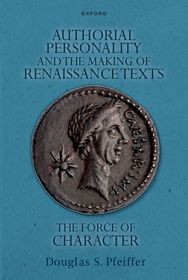
Authorial Personality and the Making of Renaissance Texts
The Force of Character
- Publisher's listprice GBP 30.00
-
14 332 Ft (13 650 Ft + 5% VAT)
The price is estimated because at the time of ordering we do not know what conversion rates will apply to HUF / product currency when the book arrives. In case HUF is weaker, the price increases slightly, in case HUF is stronger, the price goes lower slightly.
- Discount 10% (cc. 1 433 Ft off)
- Discounted price 12 899 Ft (12 285 Ft + 5% VAT)
Subcribe now and take benefit of a favourable price.
Subscribe
14 332 Ft

Availability
printed on demand
Why don't you give exact delivery time?
Delivery time is estimated on our previous experiences. We give estimations only, because we order from outside Hungary, and the delivery time mainly depends on how quickly the publisher supplies the book. Faster or slower deliveries both happen, but we do our best to supply as quickly as possible.
Product details:
- Publisher OUP Oxford
- Date of Publication 20 February 2026
- ISBN 9780197901205
- Binding Paperback
- No. of pages488 pages
- Size 25x156x234 mm
- Weight 730 g
- Language English 689
Categories
Short description:
Studying texts by Lorenzo Valla, Erasmus, Saint Jerome, George Gascoigne, and Fulke Greville, this volume explores authorial character as an instrument of textual analysis in the scholarship of early Renaissance literature.
MoreLong description:
How did we first come to believe in a correspondence between writers' lives and their works? When did the person of the author—both as context for and target of textual interpretation—begin to matter so much to the way we read? This book traces the development of author centrism back to the early Renaissance humanists. Working against allegoresis and other traditions of non-historicizing textual reception, these innovative scholars discovered the power of engaging ancient works through the speculative reconstruction of writers' personalities and artistic motives. To trace the multi-lingual and cross-cultural rise of reading for the author, this book presents four case studies of resolutely experimental texts by and about writers of high ambition in their respective generations: Lorenzo Valla on the forger of the Donation of Constantine, Erasmus on Saint Jerome, the poet George Gascoigne on himself, and Fulke Greville on Sir Philip Sidney. An opening methodological chapter and an exhortative conclusion frame these four studies with accounts of the central lexicon—character, ethos, intention, persona—and the range of genres of evidence that contemporaries used to discern and articulate authorial character and purpose.
Constellated throughout with examples from the works of major contemporaries, including John Aubrey, John Hayward, Galileo, Machiavelli, and Shakespeare, this book resurrects a vibrant culture of biographical criticism continuous with modern practice and yet radically more attuned to the explanatory powers of probabilism and historical conjecture—the discursive middle grounds eventually displaced by the post-Enlightenment binaries of truth and fiction, history and story, fact and fable.
Our habit of evaluating books based on their author's personality has a history, and in The Force of Character Douglas Pfeiffer identifies a decisive moment in that story, locating the roots of how and why, a half-century ago, Renaissance readers began searching for the life in the works. Learned, lucid, and consistently illuminating, Pfeiffer's contribution to our understanding of authorship and biography is a major one, to which many will be indebted.
Table of Contents:
Introduction: Style and the Man
How to Judge a Book by its Author
The Peopling of Valla's De falso (1440): Character Fiction at the Origin of Modern Philology
Erasmus's Vita Hieronymi (1516): Taking Editorial Work Personally
Gascoigne's Wandering 'I' in A Hundreth Sundrie Flowres (1573) & The Posies (1575)
Fulke Greville Speaks to the Dead in A Dedication to Sir Philip Sidney (1614)
Epilogue: Biographism as Close Reading in Shakespeare's Sonnet 76 (1609) and Machiavelli's 'Letter to Vettori' (1513)

