

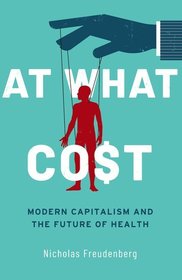
At What Cost
Modern Capitalism and the Future of Health
- Publisher's listprice GBP 22.99
-
10 379 Ft (9 885 Ft + 5% VAT)
The price is estimated because at the time of ordering we do not know what conversion rates will apply to HUF / product currency when the book arrives. In case HUF is weaker, the price increases slightly, in case HUF is stronger, the price goes lower slightly.
- Discount 10% (cc. 1 038 Ft off)
- Discounted price 9 341 Ft (8 897 Ft + 5% VAT)
Subcribe now and take benefit of a favourable price.
Subscribe
10 379 Ft

Availability
Estimated delivery time: In stock at the publisher, but not at Prospero's office. Delivery time approx. 3-5 weeks.
Not in stock at Prospero.
Why don't you give exact delivery time?
Delivery time is estimated on our previous experiences. We give estimations only, because we order from outside Hungary, and the delivery time mainly depends on how quickly the publisher supplies the book. Faster or slower deliveries both happen, but we do our best to supply as quickly as possible.
Product details:
- Publisher OUP USA
- Date of Publication 6 February 2023
- ISBN 9780197678923
- Binding Paperback
- No. of pages424 pages
- Size 155x236x24 mm
- Weight 612 g
- Language English 260
Categories
Short description:
With impeccably detailed research and an eye towards a better future, At What Cost arms ordinary citizens, activists, and health professionals with an understanding of how we've arrived at the current critical state in global health, and what we can do to ensure a healthier collective future.
MoreLong description:
An incisive and powerful investigation of corporate impact on human and planetary well-being
Freedom of choice lies at the heart of American society. Every day, individuals decide what to eat, which doctors to see, who to connect with online, and where to educate their children. Yet, many Americans don't realize that these choices are illusory at best. By the start of the 21st century, every major industrial sector in the global economy was controlled by no more than five transnational corporations, and in about a third of these sectors, a single company accounted for more than 40 percent of global sales. The available options in food, healthcare, education, transportation, and even online presence are largely constructed by corporations, whose sweeping influence have made them the public face and executive agents of 21st-century capitalism.
At What Cost confronts how globalization, financial speculation, monopolies, and control of science and technology have enhanced the ability of corporations and their allies to overwhelm influences of government, family, community, and faith. As corporations manipulate demand through skillful marketing and veto the choices that undermine their bottom line, free consumer choice has all but disappeared, and with it, the personal protections guarding our collective health. At What Cost argues that the world created by 21st-century capitalism is simply not fit to solve our most serious public health problems, from climate change to opioid addiction. However, author and public health expert Nicholas Freudenberg also shows that though the road is steep, human and planetary well-being constitute a powerful mobilizing idea for a new social movement, one that will restore the power of individual voice to our democracy.
With impeccably detailed research and an eye towards a better future, At What Cost arms ordinary citizens, activists, and health professionals with an understanding of how we've arrived at the precipice, and what we can do to ensure a healthier collective future.
an important contribution
Table of Contents:
Table of Contents
Foreward
Preface
Acknowledgments
Part I. Introduction
1. The Changing Face of U.S. and Global Capitalism
Part II. The Pillars of Health
2. Food: Ultraprocessed Products Become the Global Diet
3. Education: Private Capital Goes to School
4. Health Care: the Medical Care Industry's War on Cancer
5. Consequences of the Growth of Low-Wage and Precarious Work
6. Transportation: Uber and Autonomous Vehicles vs. Mass Transit
7. Social Connections: Extracting Profit from Human Relations
Part III. Conclusion
8. Transitions from 21st-century Capitalism
9. From Now to Next: To Build a Movement for Another World
References

