

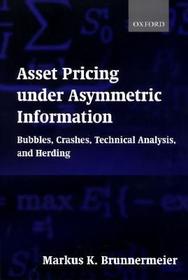
Asset Pricing under Asymmetric Information
Bubbles, Crashes, Technical Analysis, and Herding
- Publisher's listprice GBP 142.50
-
64 338 Ft (61 275 Ft + 5% VAT)
The price is estimated because at the time of ordering we do not know what conversion rates will apply to HUF / product currency when the book arrives. In case HUF is weaker, the price increases slightly, in case HUF is stronger, the price goes lower slightly.
- Discount 10% (cc. 6 433 Ft off)
- Discounted price 57 905 Ft (55 148 Ft + 5% VAT)
Subcribe now and take benefit of a favourable price.
Subscribe
64 338 Ft

Availability
printed on demand
Why don't you give exact delivery time?
Delivery time is estimated on our previous experiences. We give estimations only, because we order from outside Hungary, and the delivery time mainly depends on how quickly the publisher supplies the book. Faster or slower deliveries both happen, but we do our best to supply as quickly as possible.
Product details:
- Publisher OUP Oxford
- Date of Publication 25 January 2001
- ISBN 9780198296980
- Binding Hardback
- No. of pages262 pages
- Size 241x161x19 mm
- Weight 548 g
- Language English
- Illustrations 6 line figures 0
Categories
Short description:
The role of information is central to the academic debate on finance. This book provides a detailed, current survey of theoretical research into the effect on stock prices of the distribution of information, comparing and contrasting major models. It examines theoretical models that explain bubbles, technical analysis, and herding behavior. It also provides rational explanations for stock market crashes. Analyzing the implications of asymmetries in information is crucial in this area. This book provides a useful survey for graduate students.
MoreLong description:
Asset prices are driven by public news and information that is often dispersed among many market participants. These agents try to infer each other's information by analyzing price processes. In the past two decades, theoretical research in financial economics has significantly advanced our understanding of the informational aspects of price processes. This book provides a detailed and up-to-date survey of this important body of literature.
The book begins by demonstrating how to model asymmetric information and higher-order knowledge. It then contrasts competitive and strategic equilibrium concepts under asymmetric information. It also illustrates the dependence of information efficiency and allocative efficiency on the security structure and the linkage between both efficiency concepts. No-Trade theorems and market breakdowns due to asymmetric information are then explained, and the existence of bubbles under symmetric and asymmetric information is investigated.
The remainder of the survey is devoted to contrasting different market microstructure models that demonstrate how asymmetric information affects asset prices and traders' information , which provide a theoretical explanation for technical analysis and illustrate why some investors "chase the trend." The reader is then introduced to herding models and informational cascades, which can arise in a setting where agents' decision-making is sequential. The insights derived from herding models are used to provide rational explanations for stock market crashes. Models in which all traders are induced to search for the same piece of information are then presented to provide a deeper insight into Keynes' comparison of the stock market with a beauty contest. The book concludes with a brief summary of bank runs and their connection to financial crises.
This book develops the conceptual foundations required for the analysis of markets with asymmetric information, and uses them to provide a clear survey and synthesis of the theoretical literature on bubbles, market microstructure, crashes, and herding in financial markets. The book is not only useful to the beginner who requires a guide through the rapidly developing literature, but provides insight and perspective that the expert will also appreciate. Michael Brennan, Irwin and Goldyne Hearsh Professor of Banking and Finance at the University of California, Los Angeles, and Professor of Finance at the London Business School. President of the American Finance Association, 1989
Table of Contents:
Information, Equilibrium, Efficiency Concepts
No-Trade Theorems, Asset Pricing, Bubbles
Market Microstructure Models
Dynamic Models, Technical Analysis and Volume
Herding and Informational Cascades
Crashes, Investigative Herding, Bank Runs

