

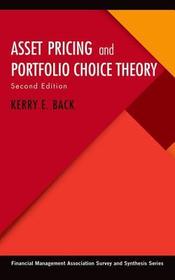
Asset Pricing and Portfolio Choice Theory
Series: Financial Management Association Survey and Synthesis Series;
- Publisher's listprice GBP 140.00
-
66 885 Ft (63 700 Ft + 5% VAT)
The price is estimated because at the time of ordering we do not know what conversion rates will apply to HUF / product currency when the book arrives. In case HUF is weaker, the price increases slightly, in case HUF is stronger, the price goes lower slightly.
- Discount 10% (cc. 6 689 Ft off)
- Discounted price 60 197 Ft (57 330 Ft + 5% VAT)
Subcribe now and take benefit of a favourable price.
Subscribe
66 885 Ft

Availability
printed on demand
Why don't you give exact delivery time?
Delivery time is estimated on our previous experiences. We give estimations only, because we order from outside Hungary, and the delivery time mainly depends on how quickly the publisher supplies the book. Faster or slower deliveries both happen, but we do our best to supply as quickly as possible.
Product details:
- Edition number 2
- Publisher OUP USA
- Date of Publication 2 March 2017
- ISBN 9780190241148
- Binding Hardback
- No. of pages744 pages
- Size 236x157x38 mm
- Weight 1179 g
- Language English 0
Categories
Short description:
This book is a textbook at the Ph.D. or Masters in Quantitative Finance level. It covers single-period, discrete-time, and continuous-time financial models. It provides introductions to many current research topics, and each chapter contains exercises.
MoreLong description:
In the 2nd edition of Asset Pricing and Portfolio Choice Theory, Kerry E. Back offers a concise yet comprehensive introduction to and overview of asset pricing. Intended as a textbook for asset pricing theory courses at the Ph.D. or Masters in Quantitative Finance level with extensive exercises and a solutions manual available for professors, the book is also an essential reference for financial researchers and professionals, as it includes detailed proofs and calculations as section appendices.
The first two parts of the book explain portfolio choice and asset pricing theory in single-period, discrete-time, and continuous-time models. For valuation, the focus throughout is on stochastic discount factors and their properties. A section on derivative securities covers the usual derivatives (options, forwards and futures, and term structure models) and also applications of perpetual options to corporate debt, real options, and optimal irreversible investment. A chapter on "explaining puzzles " and the last part of the book provide introductions to a number of additional current topics in asset pricing research, including rare disasters, long-run risks, external and internal habits, asymmetric and incomplete information, heterogeneous beliefs, and non-expected-utility preferences. Each chapter includes a "Notes and References" section providing additional pathways to the literature. Each chapter also includes extensive exercises.
Table of Contents:
I. SINGLE-PERIOD MODELS
1. Utility and Risk Aversion
2. Portfolio Choice
3. Stochastic Discount Factors
4. Equilibrium and Efficiency
5. Mean-Variance Analysis
6. Factor Models
7. Representative Investors
II. DYNAMIC MODELS
8. Dynamic Securities Markets
9. Dynamic Portfolio Choice
10. Dynamic Asset Pricing
11. Explaining Puzzles
12. Brownian Motion and Stochastic Calculus
13. Continuous-Time Markets
14. Continuous-Time Portfolio Choice and Pricing
15. Continuous-Time Topics
III. DERIVATIVE SECURITIES
16. Option Pricing
17. Forwards, Futures, and More Option Pricing
18. Term Structure Models
19. Perpetual Options and the Leland Model
20. Real Options and q Theory
IV. BELIEFS, INFORMATION, AND PREFERENCES
21. Heterogeneous Beliefs
22. Rational Expectations Equilibria
23. Learning
24. Information, Strategic Trading, and Liquidity
25. Alternative Preferences

