

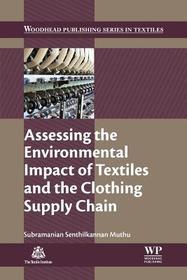
Assessing the Environmental Impact of Textiles and the Clothing Supply Chain
Series: The Textile Institute Book Series;
- Publisher's listprice EUR 149.00
-
61 797 Ft (58 855 Ft + 5% VAT)
The price is estimated because at the time of ordering we do not know what conversion rates will apply to HUF / product currency when the book arrives. In case HUF is weaker, the price increases slightly, in case HUF is stronger, the price goes lower slightly.
- Discount 10% (cc. 6 180 Ft off)
- Discounted price 55 618 Ft (52 970 Ft + 5% VAT)
Subcribe now and take benefit of a favourable price.
Subscribe
61 797 Ft

Availability
cancelled
Why don't you give exact delivery time?
Delivery time is estimated on our previous experiences. We give estimations only, because we order from outside Hungary, and the delivery time mainly depends on how quickly the publisher supplies the book. Faster or slower deliveries both happen, but we do our best to supply as quickly as possible.
Product details:
- Publisher Woodhead Publishing
- Date of Publication 30 October 2018
- ISBN 9780081013946
- Binding Paperback
- No. of pages212 pages
- Language English 0
Categories
Long description:
The textile industry impacts the environment in a number of ways, including its use of resources, its impact on global warming, and the amount of pollution and waste it generates. Assessing the Environmental Impact of Textiles and the Clothing Supply Chain reviews methods used to calculate this environmental impact, including product carbon footprints (PCFs), ecological footprints (EFs), and life cycle assessment (LCA).
The first chapters provide an introduction to the textile supply chain and its environmental impact, and an overview of the methods used to measure this impact. The book goes on to consider different environmental impacts of the industry, including greenhouse gas emissions, the water and energy footprints of the industry, and depletion of resources, as well as the use of LCA to assess the overall environmental impact of the textile industry. It then deals with the practice of measuring these impacts before forming a conclusion about the environmental impact of the industry.
Assessing the Environmental Impact of Textiles and the Clothing Supply Chain provides a standard reference for R&D managers in the textile industry and academic researchers in textile science.
- Reviews the main methods used to calculate the textile industry's use of resources, its impact on global warming and the pollution and waste it generates
- Reviews the key methods, their principles and how they can be applied in practice to measure and reduce the environmental impact of textile products
- Includes the following calculation methods: product carbon footprints (PCFs), ecological footprints (EFs) and life cycle assessment (LCA)

