

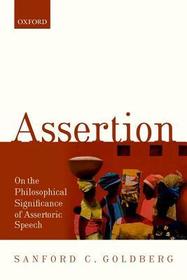
Assertion
On the Philosophical Significance of Assertoric Speech
- Publisher's listprice GBP 34.99
-
15 797 Ft (15 045 Ft + 5% VAT)
The price is estimated because at the time of ordering we do not know what conversion rates will apply to HUF / product currency when the book arrives. In case HUF is weaker, the price increases slightly, in case HUF is stronger, the price goes lower slightly.
- Discount 10% (cc. 1 580 Ft off)
- Discounted price 14 218 Ft (13 541 Ft + 5% VAT)
Subcribe now and take benefit of a favourable price.
Subscribe
15 797 Ft

Availability
printed on demand
Why don't you give exact delivery time?
Delivery time is estimated on our previous experiences. We give estimations only, because we order from outside Hungary, and the delivery time mainly depends on how quickly the publisher supplies the book. Faster or slower deliveries both happen, but we do our best to supply as quickly as possible.
Product details:
- Publisher OUP Oxford
- Date of Publication 1 February 2018
- ISBN 9780198801573
- Binding Paperback
- No. of pages330 pages
- Size 234x157x18 mm
- Weight 514 g
- Language English 0
Categories
Short description:
Sanford C. Goldberg presents a novel account of the speech act of assertion. He argues that this type of speech act is answerable to an epistemic, context-sensitive norm. On this basis he shows the philosophical importance of assertion for key debates in philosophy of language and mind, epistemology, and ethics.
MoreLong description:
Sanford C. Goldberg presents a novel account of the speech act of assertion. He defends the view that this type of speech act is answerable to a constitutive norm--the norm of assertion. The hypothesis that assertion is answerable to a robustly epistemic norm is uniquely suited to explain assertion's philosophical significance--its connections to other philosophically interesting topics. These include topics in epistemology (testimony and testimonial knowledge; epistemic authority; disagreement), the philosophy of mind (belief; the theory of mental content), the philosophy of language (norms of language; the method of interpretation; the theory of linguistic content), ethics (the ethics of belief; what we owe to each other as information-seeking creatures), and other matters which transcend any subcategory (anonymity; trust; the division of epistemic labor; Moorean paradoxicality). Goldberg aims to bring out these connections without assuming anything about the precise content of assertion's norm, beyond regarding it as robustly epistemic. In the last section of the book, however, he proposes that we do best to see the norm's epistemic standard as set in a context-sensitive fashion. After motivating this proposal by appeal to Grice's Cooperative Principle and spelling it out in terms of what is mutually believed in the speech context, Goldberg concludes by noting how this sort of context-sensitivity can be made to square with assertion's philosophical significance.
This is an excellent piece of philosophy and an essential contribution to the literature on assertion. Goldberg knows the terrain far better than most do, and his discussion is acute, fair-minded, and enlightening. Even a reader who retains at the end apreference for an alternative position will put the book down less confidently than it was picked up.
Table of Contents:
Part I: Introduction
What is Assertion? In defense of the norm-based account
Part II: The Epistemic Significance of Assertion
Assertion and the spread of knowledge
Assertion and Testimony
Part III: Other Applications: Mind, Language, and More
Assertion and the Method of Interpretation (Radical and Otherwise)
Assertion and Assertoric Content
Assertion and Belief
The Ethics of Assertion (and Belief)
Anonymous Assertion
Part IV: A case for context-sensitivity in the Norm of Assertion
Assertion and Disagreement
Mutuality and Assertion
The Costs of Context-Sensitivity

