

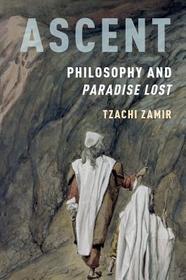
Ascent
Philosophy and Paradise Lost
- Publisher's listprice GBP 59.00
-
28 187 Ft (26 845 Ft + 5% VAT)
The price is estimated because at the time of ordering we do not know what conversion rates will apply to HUF / product currency when the book arrives. In case HUF is weaker, the price increases slightly, in case HUF is stronger, the price goes lower slightly.
- Discount 10% (cc. 2 819 Ft off)
- Discounted price 25 369 Ft (24 161 Ft + 5% VAT)
Subcribe now and take benefit of a favourable price.
Subscribe
28 187 Ft

Availability
printed on demand
Why don't you give exact delivery time?
Delivery time is estimated on our previous experiences. We give estimations only, because we order from outside Hungary, and the delivery time mainly depends on how quickly the publisher supplies the book. Faster or slower deliveries both happen, but we do our best to supply as quickly as possible.
Product details:
- Publisher OUP USA
- Date of Publication 4 January 2018
- ISBN 9780190695088
- Binding Hardback
- No. of pages216 pages
- Size 142x211x22 mm
- Weight 340 g
- Language English 0
Categories
Short description:
Engaging with heady topics such as knowledge, meaningful agency, vitality, and gratitude, Ascent advances an argument regarding Milton's Paradise Lost and the role of the imagination in religion. Miltonists are offered not a contextualization of Milton's views relative to his contemporaries or predecessors, but rather an attempt to bring him into conversation with pressing topics of contemporary philosophy.
MoreLong description:
Paradise Lost has never received a substantial, book-length reading by a philosopher. This, however should surprise no one, for Milton himself despised philosophers. He associated philosophy with deceit in his theological writings, and made philosophizing into one of the activities of fallen angels in hell. Yet, in this book, philosopher and literary critic Tzachi Zamir argues that Milton's disdain for their vocation should not prevent philosophers from turning an inquisitive eye to Paradise Lost. Because Milton's greatest poem conducts a multilayered examination of puzzles that intrigue philosophers, instead of neatly breaking from philosophy, it maintains a penetrating rapport with it. Paradise Lost sets forth bold claims regarding the meaning of genuine knowledge, or acting meaningfully, or taking in the world fully, or successfully withdrawing from inner deadness. Other topics touched upon by Milton involve some of the most central issues within the philosophy of religion: the relationship between reason and belief, the uniqueness of religious poetry, the meaning of gratitude, and the special role of the imagination in faith. This tension-disparaging philosophy on the one hand, but taking up much of what philosophers hope to understand on the other-turns Milton's poem into an exceptionally potent work for a philosopher of literature. Ascent is a philosophical reading of the poem that attempts to keep audible Milton's anti-philosophy stance. The picture of interdisciplinarity that emerges is, accordingly, neither one of a happy percolation among fields ('philosophy', 'literature'), nor one of rigid boundaries. Overlap and partial agreement clash against contestation and rivalry. It is these conflicting currents which Ascent aims to capture, if not to reconcile.
There is much else we may be stimulated to find by thinking through this fine addition to Milton scholarship.
Table of Contents:
Acknowledgments
Introduction
1. At the Base Camp -- Imagining
2. First Climb -- Wisdom
3. First Crossroad -- Knowledge
4. Second Climb -- Meaningful Action
5. Second Crossroad -- Purchase
6. Third Climb -- Meaningless Action
7. Third Crossroad -- Place
8. Fourth Climb -- Receiving
9. Fourth Crossroad -- Needs
10. Fifth Climb -- Gratitude
11. Fifth Crossroad -- Sin
12. At the Summit

