

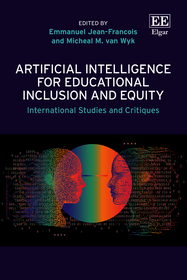
Artificial Intelligence for Educational Inclusion and Equity
International Studies and Critiques
- Publisher's listprice GBP 120.00
-
54 180 Ft (51 600 Ft + 5% VAT)
The price is estimated because at the time of ordering we do not know what conversion rates will apply to HUF / product currency when the book arrives. In case HUF is weaker, the price increases slightly, in case HUF is stronger, the price goes lower slightly.
- Discount 10% (cc. 5 418 Ft off)
- Discounted price 48 762 Ft (46 440 Ft + 5% VAT)
Subcribe now and take benefit of a favourable price.
Subscribe
54 180 Ft

Availability
Estimated delivery time: In stock at the publisher, but not at Prospero's office. Delivery time approx. 3-5 weeks.
Not in stock at Prospero.
Why don't you give exact delivery time?
Delivery time is estimated on our previous experiences. We give estimations only, because we order from outside Hungary, and the delivery time mainly depends on how quickly the publisher supplies the book. Faster or slower deliveries both happen, but we do our best to supply as quickly as possible.
Product details:
- Publisher Edward Elgar Publishing
- Date of Publication 22 May 2026
- ISBN 9781035346424
- Binding Hardback
- No. of pages286 pages
- Size 234x156 mm
- Weight 532 g
- Language English 791
Categories
Short description:
This timely book evaluates how artificial intelligence can advance educational inclusion, and equity, addressing its best practices and critiques in P-20 education across the Global North and South. Chapters provide crucial insights into the planning, development, and implementation of AI within educational courses, programs and institutions.
MoreLong description:
This timely book evaluates how artificial intelligence can advance educational inclusion and equity, addressing its best practices and critiques in P-20 education across the Global North and South. Chapters provide crucial insights into the planning, development, and implementation of AI within educational courses, programs, and institutions.
Drawing on unique practical frameworks, contributors demonstrate how educators can integrate AI technologies into instructional leadership to enhance creativity, critical thinking, and analysis. They explore how this emerging technology can be used ethically by students to aid learning and close academic achievement gaps. Presenting crucial policy recommendations based on scholarly studies and real-world case analyses, the book highlights strategies for ensuring AI technologies and detectors are implemented fairly, with particular focus on the needs of students from historically marginalized communities.
Artificial Intelligence for Educational Inclusion and Equity is a valuable resource for scholars, students, and educators interested in the equitable use of AI technologies. It is also beneficial for practitioners and policymakers looking to understand evidence-based practices and effective pedagogical applications.
‘In Artificial Intelligence for Educational Inclusion and Equity, the authors artfully examine the dualistic nature of generative AI to transform learning while exacerbating inequities in education and the economy. Their critical analyses highlight actionable ways for supporting AI literacy and inclusion among students and educators to overcome these barriers.’
Table of Contents:
Contents
1 Introduction 1
Emmanuel Jean-Francois and Micheal M. van Wyk
PART 1 AI AND THE CHALLENGES OF DIVERSITY
INCLUSION, EQUITY, AND ETHICS
2 Diversity inclusion, equity, and artificial intelligence 13
Emmanuel Jean-Francois
3 Bridging the digital divide in education: Global and local
perspectives 34
Neil D. Grimes and Sara Platt
4 “A whole cartload of beautiful possibilities”: Moral guidance
and the paradigm shift of generative AI 65
Jason Todd
5 Critical perspective on artificial intelligence in education 83
Patrick Kersale
PART 2 HUMAN RESOURCE DEVELOPMENT AND
EDUCATIONAL LEADERSHIP FOR INCLUSIVE
AND EQUITABLE AI INTEGRATION
6 Artificial intelligence and human resource development:
Efficiency and equity 99
Nomita Sharma
7 AI for educational inclusion and equity: Academic leadership
and policy for ethical integration in the Global South 116
Michael M. van Wyk
8 AI as part of a process of change in Argentine educational
management in pursuit of equity and inclusion 132
Cristina Adriana Kruger
9 AI and the ethical dimension of educational leadership 148
Charles L. Lowery
PART 3 AI FOR INCLUSION AND EQUITY IN
CURRICULUM AND INSTRUCTION
10 Trust in artificial intelligence: Challenges of educational
equity and ethics in students’ practices in German higher
education 162
Therese Rosemann, Marie Rathmann, Jan Schiller, and
Sabine Schmidt-Lauff
11 Digitalization and artificial intelligence for enhancing
inclusive and equitable education in Finland 188
Sari Havu-Nuutinen and Sini Kontkanen
12 Educational integration of artificial intelligence: Like it or not
AI is changing the way we teach and learn 210
María Dolores Lasso and Camila Carpio Frixone
13 Mitigating teacher burnout and facilitating career pathways 222
Claire Ramsey
14 Reclaiming AI equity in special education: Justice in a post-
federal era 244
Jimmy R. Caldwell

