

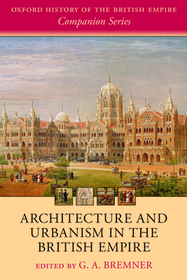
Architecture and Urbanism in the British Empire
Series: Oxford History of the British Empire Companion Series;
- Publisher's listprice GBP 44.99
-
20 312 Ft (19 345 Ft + 5% VAT)
The price is estimated because at the time of ordering we do not know what conversion rates will apply to HUF / product currency when the book arrives. In case HUF is weaker, the price increases slightly, in case HUF is stronger, the price goes lower slightly.
- Discount 10% (cc. 2 031 Ft off)
- Discounted price 18 281 Ft (17 411 Ft + 5% VAT)
Subcribe now and take benefit of a favourable price.
Subscribe
20 312 Ft

Availability
printed on demand
Why don't you give exact delivery time?
Delivery time is estimated on our previous experiences. We give estimations only, because we order from outside Hungary, and the delivery time mainly depends on how quickly the publisher supplies the book. Faster or slower deliveries both happen, but we do our best to supply as quickly as possible.
Product details:
- Publisher OUP Oxford
- Date of Publication 8 April 2020
- ISBN 9780198844051
- Binding Paperback
- No. of pages496 pages
- Size 229x155x27 mm
- Weight 764 g
- Language English
- Illustrations numerous black and white figures/illustrations 0
Categories
Short description:
A comprehensive overview of the architectural and urban transformations that took place across the British Empire between the seventeenth and mid-twentieth centuries, exploring the built heritage of Britain's former colonial empire as a fundamental part of how we negotiate our postcolonial identities.
MoreLong description:
Throughout today's postcolonial world, buildings, monuments, parks, streets, avenues, entire cities even, remain as witness to Britain's once impressive if troubled imperial past. These structures are a conspicuous and near inescapable reminder of that past, and therefore, the built heritage of Britain's former colonial empire is a fundamental part of how we negotiate our postcolonial identities, often lying at the heart of social tension and debate over how that identity is best represented.
This volume provides an overview of the architectural and urban transformations that took place across the British Empire between the seventeenth and mid-twentieth centuries. Although much research has been carried out on architecture and urban planning in Britain's empire in recent decades, no single, comprehensive reference source exists. The essays compiled here remedy this deficiency. With its extensive chronological and regional coverage by leading scholars in the field, this volume will quickly become a seminal text for those who study, teach, and research the relationship between empire and the built environment in the British context. It provides an up-to-date account of past and current historiographical approaches toward the study of British imperial and colonial architecture and urbanism, and will prove equally useful to those who study architecture and urbanism in other European imperial and transnational contexts.
The volume is divided in two main sections. The first section deals with overarching thematic issues, including building typologies, major genres and periods of activity, networks of expertise and the transmission of ideas, the intersection between planning and politics, as well as the architectural impact of empire on Britain itself. The second section builds on the first by discussing these themes in relation to specific geographical regions, teasing out the variations and continuities observable in context, both practical and theoretical.
The authors demonstrate how the British used the forces of urbanism and architecture to assert control over the empire, and the continued presence of many of these buildings today symbolises the permanence of British Influence ... launching new ventures into a huge field of study.
Table of Contents:
Introduction
Architecture, Urbanism, and British Imperial Studies
PART I: Themes in British Imperial and Colonial Architecture and Urbanism
Beginnings: Early Colonial Architecture
Urbanism and Master Planning: Configuring the Colonial City
Stones of Empire: Monuments, Memorials, and Manifest Authority
The Metropolis: Imperial Buildings and Landscapes in Britain
Propagating Ideas and Institutions: Religious and Educational Architecture
Imperial Modernism
Part II Regional Continuity, Divergence, and Variation in the British World
British North America and the West Indies
South and Southeast Asia
The Australian Colonies
New Zealand and the Pacific
Sub-Saharan Africa
Egypt and Mandatory Palestine and Iraq

