

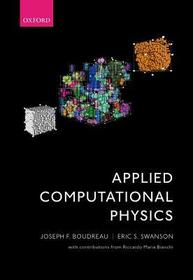
Applied Computational Physics
- Publisher's listprice GBP 68.00
-
32 487 Ft (30 940 Ft + 5% VAT)
The price is estimated because at the time of ordering we do not know what conversion rates will apply to HUF / product currency when the book arrives. In case HUF is weaker, the price increases slightly, in case HUF is stronger, the price goes lower slightly.
- Discount 10% (cc. 3 249 Ft off)
- Discounted price 29 238 Ft (27 846 Ft + 5% VAT)
Subcribe now and take benefit of a favourable price.
Subscribe
32 487 Ft

Availability
printed on demand
Why don't you give exact delivery time?
Delivery time is estimated on our previous experiences. We give estimations only, because we order from outside Hungary, and the delivery time mainly depends on how quickly the publisher supplies the book. Faster or slower deliveries both happen, but we do our best to supply as quickly as possible.
Product details:
- Publisher OUP Oxford
- Date of Publication 21 December 2017
- ISBN 9780198708643
- Binding Paperback
- No. of pages936 pages
- Size 247x172x44 mm
- Weight 1760 g
- Language English
- Illustrations Over 200 illustrations 0
Categories
Short description:
A textbook that addresses a wide variety of problems in classical and quantum physics. Modern programming techniques are stressed throughout, along with the important topics of encapsulation, polymorphism, and object-oriented design. Scientific problems are physically motivated, solution strategies are developed, and explicit code is presented.
MoreLong description:
Applied Computational Physics is a graduate-level text stressing three essential elements: advanced programming techniques, numerical analysis, and physics. The goal of the text is to provide students with essential computational skills that they will need in their careers, and to increase the confidence with which they write computer programs designed for their problem domain. The physics problems give them an opportunity to reinforce their programming skills, while the acquired programming skills augment their ability to solve physics problems. The C++ language is used throughout the text. Physics problems include Hamiltonian systems, chaotic systems, percolation, critical phenomena, few-body and multi-body quantum systems, quantum field theory, simulation of radiation transport, and data modeling.
The book, the fruit of a collaboration between a theoretical physicist and an experimental physicist, covers a broad range of topics from both viewpoints. Examples, program libraries, and additional documentation can be found at the companion website. Hundreds of original problems reinforce programming skills and increase the ability to solve real-life physics problems at and beyond the graduate level.
This is an extremely user friendly and compact introduction to almost all the computational and numerical aspects of physics at the graduate level. It can also be used as a self-study text, and, once mastered, will serve as a useful reference... I have no hesitations in recommending this book for science and engineering students who are either looking for a supplementary textbook other than what is being used in their classrooms, or, who want to venture into the world of computing on their own.
Table of Contents:
Building Programs in an Linux Environment
Encapsulation and the C++ class
Some Useful Classes with Applications
Interpolation and Extrapolation
Numerical Quadrature
How to Write a Class
Monte Carlo Methods
Precolation and Universality
Parallel Computing
Graphics for Physicists
Ordinary Differential Equations
Polymorphism
Nonlinear Dynamics and Chaos
Rotations and Lorentz Transformations
Simulation
Data Modeling
Templates, the Standard C++ Library, and Modern C++
Many Body Dynamics
Continuum Dynamics
Classical Spin Systems
Quantum Mechanics I - Few Body Systems
Quantum Spin Systems
Quantum Mechanics II - Many Body Systems
Quantum Field Theory

