

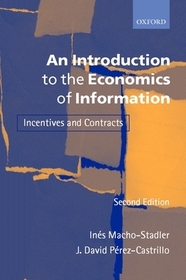
An Introduction to the Economics of Information
Incentives and Contracts
- Publisher's listprice GBP 63.00
-
28 444 Ft (27 090 Ft + 5% VAT)
The price is estimated because at the time of ordering we do not know what conversion rates will apply to HUF / product currency when the book arrives. In case HUF is weaker, the price increases slightly, in case HUF is stronger, the price goes lower slightly.
- Discount 10% (cc. 2 844 Ft off)
- Discounted price 25 600 Ft (24 381 Ft + 5% VAT)
Subcribe now and take benefit of a favourable price.
Subscribe
28 444 Ft

Availability
printed on demand
Why don't you give exact delivery time?
Delivery time is estimated on our previous experiences. We give estimations only, because we order from outside Hungary, and the delivery time mainly depends on how quickly the publisher supplies the book. Faster or slower deliveries both happen, but we do our best to supply as quickly as possible.
Product details:
- Edition number 2
- Publisher OUP Oxford
- Date of Publication 8 March 2001
- ISBN 9780199243259
- Binding Paperback
- No. of pages302 pages
- Size 234x156x17 mm
- Weight 473 g
- Language English
- Illustrations line figures 0
Categories
Short description:
This is a graduate textbook on the theory of contracting under asymmetric information, a key part of modern microeconomic theory. It examines the characteristics of optimal contracts when one party has certain relevant knowledge that the other party does not. The various problems are presented in the same framework to allow easy comparison of the different results. The authors indicate substantial real-world applications, and exercises for students (with solutions) are provided at the end of each chapter.
MoreLong description:
This is a graduate textbook on the theory of contracting under asymmetric information, a key part of modern microeconomic theory. It examines the characteristics of optimal contracts when one party has certain relevant knowledge that the other party does not. The various problems are presented in the same framework to allow easy comparison of the different results. The authors indicate substantial real-world applications, and exercises for students (with solutions) are provided at the end of each chapter.
It is a timely contribution to the discipline of Economics as a whole and in particular to Information Economics.

