

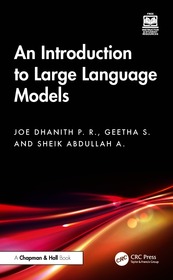
An Introduction to Large Language Models
-
GET 10% OFF
- Publisher's listprice GBP 54.99
-
24 827 Ft (23 645 Ft + 5% VAT)
The price is estimated because at the time of ordering we do not know what conversion rates will apply to HUF / product currency when the book arrives. In case HUF is weaker, the price increases slightly, in case HUF is stronger, the price goes lower slightly.
- Discount 10% (cc. 2 482 Ft off)
- Discounted price 22 345 Ft (21 281 Ft + 5% VAT)
22 345 Ft

Availability
Not yet published.
Why don't you give exact delivery time?
Delivery time is estimated on our previous experiences. We give estimations only, because we order from outside Hungary, and the delivery time mainly depends on how quickly the publisher supplies the book. Faster or slower deliveries both happen, but we do our best to supply as quickly as possible.
Product details:
- Edition number 1
- Publisher Chapman and Hall
- Date of Publication 30 October 2026
- ISBN 9781041086277
- Binding Paperback
- No. of pages352 pages
- Size 234x156 mm
- Language English
- Illustrations 56 Illustrations, black & white; 4 Halftones, black & white; 52 Line drawings, black & white; 4 Tables, black & white 700
Categories
Short description:
The book offers an introduction to Large Language Models that bridge foundational natural language processing (NLP) concepts with the advanced techniques underlying large language models (LLMs).
MoreLong description:
The book offers an introduction to large language models (LLMs) that bridge foundational natural language processing (NLP) concepts with the advanced techniques underlying large language models. It offers a structured exploration of NLP evolution, from rule- based approaches to transformer architectures. Covering key principles such as tokenization, attention mechanisms, and model architectures (BERT, GPT, T5), the book explains pretraining objectives like masked and causal language modeling. It also addresses optimization techniques such as LoRA, pruning, and quantization for efficient LLM deployment. Multimodal models, including GPT- 4 and PaLM- E, are explored alongside retrieval- augmented generation and AI- powered agents.
Features:
• Discusses foundational NLP concepts, theoretical depth, advanced techniques, and real- world applications.
• Covers perplexity, BLEU, ROUGE, and datasets like SuperGLUE and SQuAD for assessing LLM performance, discusses LoRA, pruning, and quantization to optimize LLM deployment in resource- constrained settings.
• Explores GPT- 4, PaLM- E, and retrieval- augmented generation, expanding beyond traditional NLP models.
• Provides Python implementations for fine- tuning, classification, summarization, and conversational AI tasks.
• Highlights use cases in text generation, code generation, sentiment analysis, and multimodal AI.
This book is an invaluable textbook for students, researchers, and industry professionals seeking a deep technical understanding of LLMs and their applications.
More
Table of Contents:
Chapter 1. Introduction to Natural Language Processing (NLP). 1.1 Brief History of NLP. 1.2 Key NLP Tasks. 1.3 Basics of Language Models. 1.4 Challenges in NLP. Chapter 2. Linguistic Foundations and Feature Representation of NLP. 2.1 Levels of NLP in computational linguistics. 2.2 Morphology. 2.3 Syntax and Semantics. 2.4 Lexical and Compositional Semantics. 2.5 Vector Space Model (VSM). 2.6 Word Embeddings. Chapter 3. Sequence Modelling with Neural Networks. 3.1 Recurrent Neural Networks (RNNs). 3.2 Convolutional Neural Networks (CNNs) for NLP. 3.3 Sequence-to-Sequence (Seq2Seq) Models. Chapter 4. Attention Mechanism and Pre-trained Language Models. 4.1 Introduction to the Transformer Architecture. 4.2 Attention Mechanism. 4.3 Pretrained Language Models. 4.4 Pretraining Objectives: MLM and Causal LM. 4.5 Fine-Tuning vs. Prompting. 4.6 Transfer Learning for NLP. Chapter 5. Fundamentals of Large Language Models. 5.1 Tokenization. 5.2 Encoding Positions. 5.3 Activation Functions. 5.4 Layer Normalization. 5.5 Distributed LLM Training. 5.6 Libraries. Chapter 6. Variants of LLM Architecture. 6.1 Encoder-only architecture. 6.2 Decoder-only architecture. 6.3 Encoder-Decoder architecture. 6.4 Other variants. Chapter 7. Pre-Trained LLMs. 7.1 Single Modal pre-trained LLMs.7.2 Multi Modal pre-trained LLMs. Chapter 8. Fine Tuning of LLMs. 8.1 Introduction to Fine-tuning. 8.2 Process of LLM fine-tuning. 8.3 Types of Fine-tuning methods. 8.4 Instruction Tuning. 8.5 Alignment Techniques. 8.6 Advanced Fine-tuning Techniques. 8.7 Challenges in Fine-tuning. Chapter 9. Efficient Large Language Models (LLMs). 9.1 Introduction to Efficient LLMs. 9.2 Parameter-Efficient Fine-Tuning Techniques. 9.3 Quantization Techniques. 9.4 Pruning Strategies. 9.5 Efficient Attention Mechanisms. 9.6 Distributed and Parallel Computing for LLMs. 9.7 Energy Efficiency in LLM Inference. 9.8 Optimizing LLMs for Edge Devices. 9.9 Practical Applications of Efficient LLMs. Chapter 10. Increasing Context Window. 10.1 Position Interpolation. 10.2 Efficient Attention Mechanism. 10.3 Extrapolation without Training. Chapter 11. Augmented LLMs. 11.1 Retrieval Augmented LLMs-Introduction. 11.2 Classification of Retrieval Augmented LLMs. 11.3 Retrieval Augmented Generation (RAG). Chapter 12. LLMs-Powered Agents. 12.1 LLMs Steering Autonomous Agents. 12.2 LLMs in Physical Environment. Chapter 13. Evaluation of LLMs. 13.1 Natural Language Understanding. 13.2 Natural Language Generation. 13.3 Metrics for Language Models. 13.4 Benchmarking LLMs. Chapter 14. Applications of Large Language Models. 14.1 Generative Applications. 14.2 Task-Specific Applications. 14.3 Multimodal Language Models. Chapter 15. Ethical Considerations in Large Language Models. 15.1 Introduction. 15.2 Bias and Fairness in LLMs. 15.3 Explainability and Transparency. 15.4 Privacy and Data Protection. 15.5 Misinformation and Content Moderation. 15.6 Intellectual Property and Plagiarism. 15.7 Environmental Impact of LLMs. 15.8 Regulation and Governance of LLMs. 15.9 Ethical Use Cases and Best Practices
More
