

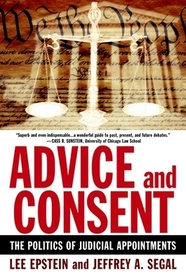
Advice and Consent
The Politics of Judicial Appointments
- Publisher's listprice GBP 8.99
-
4 058 Ft (3 865 Ft + 5% VAT)
The price is estimated because at the time of ordering we do not know what conversion rates will apply to HUF / product currency when the book arrives. In case HUF is weaker, the price increases slightly, in case HUF is stronger, the price goes lower slightly.
- Discount 10% (cc. 406 Ft off)
- Discounted price 3 652 Ft (3 479 Ft + 5% VAT)
Subcribe now and take benefit of a favourable price.
Subscribe
4 058 Ft

Availability
Out of print
Why don't you give exact delivery time?
Delivery time is estimated on our previous experiences. We give estimations only, because we order from outside Hungary, and the delivery time mainly depends on how quickly the publisher supplies the book. Faster or slower deliveries both happen, but we do our best to supply as quickly as possible.
Product details:
- Edition number New ed
- Publisher Oxford University Press
- Date of Publication 22 March 2007
- ISBN 9780195315837
- Binding Paperback
- No. of pages192 pages
- Size 226x145x15 mm
- Weight 277 g
- Language English
- Illustrations 6 halftones 0
Categories
Short description:
Here, two leading legal scholars, Lee Epstein and Jeffrey A. Segal, offer a brief, illuminating survey on the nomination of federal judges. The authors discuss everything from constitutional background to the crucial differences in the nomination of judges and justices and the role of the Judiciary Committee in vetting nominees. They also shed light on the different roles played by the media, the American Bar Association, and special interest groups in getting judges
nominated?or rejected. The authors discuss the history of this highly contentious process, from the days of FDR to today's debated "reforms," such as the so-called "nuclear option." They present an invaluable guide through the occasionally murky history of American court appointments, one that will
prepare you for the many contentious debates that are surely destined to come.
Long description:
From Louis Brandeis to Robert Bork to Clarence Thomas, the nomination of federal judges has generated intense political conflict. With the coming retirement of one or more Supreme Court Justices?and threats to filibuster lower court judges?the selection process is likely to be, once again, the center of red-hot partisan debate.
In Advice and Consent, two leading legal scholars, Lee Epstein and Jeffrey A. Segal, offer a brief, illuminating Baedeker to this highly important procedure, discussing everything from constitutional background, to crucial differences in the nomination of judges and justices, to the role of the Judiciary Committee in vetting nominees. Epstein and Segal shed light on the role played by the media, by the American Bar Association, and by special interest groups (whose efforts helped
defeat Judge Bork). Though it is often assumed that political clashes over nominees are a new phenomenon, the authors argue that the appointment of justices and judges has always been a highly contentious process?one largely driven by ideological and partisan concerns. The reader discovers how presidents
and the senate have tried to remake the bench, ranging from FDR's controversial "court packing" scheme to the Senate's creation in 1978 of 35 new appellate and 117 district court judgeships, allowing the Democrats to shape the judiciary for years. The authors conclude with possible "reforms," from the so-called nuclear option, whereby a majority of the Senate could vote to prohibit filibusters, to the even more dramatic suggestion that Congress eliminate a judge's life tenure either by term
limits or compulsory retirement.
With key appointments looming on the horizon, Advice and Consent provides everything concerned citizens need to know to understand the partisan rows that surround the judicial nominating process.
"This is a superb and even indispensable resource. Careful, precise, objective, and nugget-filled, it's a wonderful guide to past, present, and future debates. If you want to know about judicial appointments, this is the best place to start."?Cass R. Sunstein, University of Chicago Law School

