

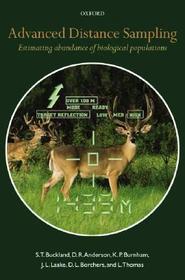
Advanced Distance Sampling
Estimating abundance of biological populations
- Publisher's listprice GBP 105.00
-
47 407 Ft (45 150 Ft + 5% VAT)
The price is estimated because at the time of ordering we do not know what conversion rates will apply to HUF / product currency when the book arrives. In case HUF is weaker, the price increases slightly, in case HUF is stronger, the price goes lower slightly.
- Discount 10% (cc. 4 741 Ft off)
- Discounted price 42 667 Ft (40 635 Ft + 5% VAT)
Subcribe now and take benefit of a favourable price.
Subscribe
47 407 Ft

Availability
printed on demand
Why don't you give exact delivery time?
Delivery time is estimated on our previous experiences. We give estimations only, because we order from outside Hungary, and the delivery time mainly depends on how quickly the publisher supplies the book. Faster or slower deliveries both happen, but we do our best to supply as quickly as possible.
Product details:
- Publisher OUP Oxford
- Date of Publication 19 August 2004
- ISBN 9780198507833
- Binding Hardback
- No. of pages436 pages
- Size 237x157x22 mm
- Weight 780 g
- Language English
- Illustrations numerous line drawings 0
Categories
Short description:
This advanced text focuses on the uses of distance sampling to estimate the density and abundance of biological populations. It addresses new methodologies, new technologies and recent developments in statistical theory and is the follow up companion to Introduction to Distance Sampling (OUP, 2001).
MoreLong description:
This advanced text focuses on the uses of distance sampling to estimate the density and abundance of biological populations. It addresses new methodologies, new technologies and recent developments in statistical theory and is the follow up companion to Introduction to Distance Sampling (OUP, 2001).
In this text, a general theoretical basis is established for methods of estimating animal abundance from sightings surveys, and a wide range of approaches to analysis of sightings data is explored. These approaches include: modelling animal detectability as a function of covariates, where the effects of habitat, observer, weather, etc. on detectability can be assessed; estimating animal density as a function of location, allowing for example animal density to be related to habitat and other locational covariates; estimating change over time in populations, a necessary aspect of any monitoring programme; estimation when detection of animals on the line or at the point is uncertain, as often occurs for marine populations, or when the survey region has dense cover; survey design and automated design algorithms, allowing rapid generation of sound survey designs using geographic information systems; adaptive distance sampling methods, which concentrate survey effort in areas of high animal density; passive distance sampling methods, which extend the application of distance sampling to species that cannot be readily detected in sightings surveys, but can be trapped; and testing of methods by simulation, so that performance of the approach in varying circumstances can be assessed.
Authored by a leading team this text is aimed at professionals in government and environment agencies,
statisticians, biologists, wildlife managers, conservation biologists and ecologists, as well as graduate students, studying the density and abundance of biological populations.
The book provides a stimulating account of recent progress with statistical methods for solving the practical problems that biologists encounter when estimating abundance.
Table of Contents:
Introduction to advanced distance sampling
General formulation for distance sampling
Covariate models
Spatial distance sampling models
Temporal inferences from distance sampling surveys
Methods for incomplete detection at distance zero
Design of distance sampling surveys and Geographic Information Systems
Adaptive distance sampling surveys
Passive approaches to detection in distance sampling
Assessment of distance sampling estimators
Further topics in distance sampling
References
Index

