

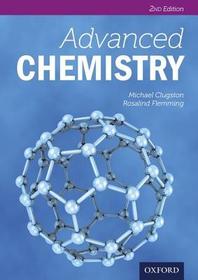
Advanced Chemistry
Series: Advanced Sciences;
- Publisher's listprice GBP 65.00
-
29 347 Ft (27 950 Ft + 5% VAT)
The price is estimated because at the time of ordering we do not know what conversion rates will apply to HUF / product currency when the book arrives. In case HUF is weaker, the price increases slightly, in case HUF is stronger, the price goes lower slightly.
- Discount 10% (cc. 2 935 Ft off)
- Discounted price 26 413 Ft (25 155 Ft + 5% VAT)
Subcribe now and take benefit of a favourable price.
Subscribe
29 347 Ft

Availability
Estimated delivery time: In stock at the publisher, but not at Prospero's office. Delivery time approx. 3-5 weeks.
Not in stock at Prospero.
Why don't you give exact delivery time?
Delivery time is estimated on our previous experiences. We give estimations only, because we order from outside Hungary, and the delivery time mainly depends on how quickly the publisher supplies the book. Faster or slower deliveries both happen, but we do our best to supply as quickly as possible.
Product details:
- Edition number 2
- Publisher OUP Oxford
- Date of Publication 11 July 2013
- ISBN 9780198392910
- Binding Paperback
- No. of pages616 pages
- Size 297x211x27 mm
- Weight 1588 g
- Language English
- Illustrations Full Colour 0
Categories
Short description:
Written by experienced teachers who bring a refreshing approach to traditional A-Level material. Advanced Chemistry will inspire and support chemistry students. Questions give opportunities to practise recall and analytical skills, and 'Maths boxes' give mathematical support. Key terms are highlighted and there are full colour illustrations.
MoreLong description:
For all mainstream AS and A Level specifications. No matter which specification you choose to follow, Advanced Chemistry provides comprehensive coverage of all the content you need to know; this revised and updated second edition will remain relevant even when specifications change. This indispensable guide takes a thorough and engaging approach to AS and A Level Chemistry.
A broad and simple summary of the breadth of the subject covered in chemistry up to GCSE level reminds students of what they learned prior to starting their A-Level course. Progressing through the book each chapter starts from the basics to help build on a student's earlier learning. Calculations are illustrated with everyday examples and applications of this knowledge. Chapters finish with practical exam questions and diagrams of subject matter covered; the book explains the chemistry of an airbag in a car for example. Other examples of objects and everyday applications include the percentage of recycled steel used in the construction of the ArcelorMittal Orbit in Stratford next to the main Olympic stadium used for London 2012.The book finishes with a number of chapters on biochemistry with carbohydrates, proteins and nucleic acids included, making this a useful introductory textbook for students wanting to learn basic biochemistry.
Table of Contents:
Chapter 1: Patterns in Chemistry
Chapter 2: The Nuclear Atom
Chapter 3: Masses of Atoms and the Mole
Chapter 4: Electrons in Atoms
Chapter 5: Chemical Bonding
Chapter 6: Solids
Chapter 7: Changes of State and Intermolecular Forces
Chapter 8: Gases
Chapter 9: Reacting Masses and Volumes
Chapter 10: Thermochemistry
Chapter 11: Chemical Equilibrium
Chapter 12: Acid Base Equilibrium
Chapter 13: Redox Equilibrium
Chapter 14: Spontaneous Change Towards Equilibrium
Chapter 15: Chemical Kinetics
Chapter 16: The S-Block Elements
Chapter 17: Trends Across A Period
Chapter 18: The Halogens
Chapter 19: The P-Block Elements
Chapter 20: The Transition Metals
Chapter 21: Introduction to Organic Chemistry
Chapter 22: Alkanes and Alkenes
Chapter 23: Arenes
Chapter 24: Organic Halogeno Compounds
Chapter 25: Alcohols
Chapter 26: Aldehydes and Ketones
Chapter 27: Carboxylic Acids and their derivatives
Chapter 28: Amines and Amino Acids
Chapter 29: Organic Synthesis : Changing the Carbon Skeleton
Chapter 30: Biochemistry
Chapter 31: Techniques of preparation, separation and identification
Chapter 32: Spectroscopy and structure

