

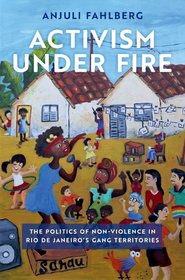
Activism under Fire
The Politics of Non-Violence in Rio de Janeiro's Gang Territories
Series: GLOBAL AND COMPARATIVE ETHNOGRAPHY SER;
- Publisher's listprice GBP 72.00
-
32 508 Ft (30 960 Ft + 5% VAT)
The price is estimated because at the time of ordering we do not know what conversion rates will apply to HUF / product currency when the book arrives. In case HUF is weaker, the price increases slightly, in case HUF is stronger, the price goes lower slightly.
- Discount 10% (cc. 3 251 Ft off)
- Discounted price 29 257 Ft (27 864 Ft + 5% VAT)
Subcribe now and take benefit of a favourable price.
Subscribe
32 508 Ft

Availability
printed on demand
Why don't you give exact delivery time?
Delivery time is estimated on our previous experiences. We give estimations only, because we order from outside Hungary, and the delivery time mainly depends on how quickly the publisher supplies the book. Faster or slower deliveries both happen, but we do our best to supply as quickly as possible.
Product details:
- Publisher OUP USA
- Date of Publication 10 July 2023
- ISBN 9780197519325
- Binding Hardback
- No. of pages308 pages
- Size 156x235x21 mm
- Weight 567 g
- Language English
- Illustrations 24 b/w photographs; 4 maps 402
Categories
Short description:
Rio de Janeiro's favelas have become well-known sites of gang and police violence. In Activism under Fire, Anjuli Fahlberg provides an original account of how conflict activism operates in Cidade de Deus, one of Rio's most dangerous and famous favelas. Based on fieldwork, virtual ethnography, and participatory action research, Fahlberg documents how activists strategically navigate local constraints and opportunities--including gendered governing dynamics and racialized practices of solidarity--to create space for non-violent governance amid armed repression.
MoreLong description:
Rio de Janeiro's favelas have become well-known sites of gang and police violence. Since the 1970s, dangerous networks between drug traffickers and corrupt state actors have transformed these poor neighborhoods into sites of armed conflict and political repression, limiting residents' ability to speak out against violence or demand their democratic rights. Despite these challenges, nonviolent politics remains an integral element in Cidade de Deus--City of God--one of Rio's most dangerous and famous favelas.
In Activism under Fire, Anjuli Fahlberg provides an original account of how conflict activism operates in Cidade de Deus. Drawing on fieldwork, virtual ethnography, and participatory action research, Fahlberg documents how activists strategically navigate local constraints and opportunities--including gendered governing dynamics and racialized practices of solidarity--to create space for non-violent governance amid armed repression. By working within urban, national, and transnational political networks and social movements, local activists bring resources into their neighborhood and protest violence while avoiding dangerous alliances.
Activism under Fire demonstrates that non-violent collective action is possible amid extreme poverty and violence, and shows what strategies enable it to survive and effect political change. In so doing, Fahlberg reveals the possibilities for collective action in violent and chaotic democratic states, not only in Latin America, but throughout the world.
How is social mobilization possible in gang territories? Anjuli Fahlberg's research answers this question, affirming the necessity to differentiate favela activism from traditional social movements. Activism under Fire is a powerful concept to understand the strategy of non-violence adopted by political actors as part of their resistance and adaptation to violent and restrictive contexts. Fahlberg's original participatory field research reveals how favela activists have constructed a sphere of non-violent politics, which operates politically parallel to, and symbolically in opposition to, the sphere of violent politics in the neighborhood.
Table of Contents:
Introduction: Conflict Activism in Rio de Janeiro's Gang Territories
1. Cidade de Deus: A Contested Territory
2. Milking the Resource Matrix: Democracy, Development, and Digital Devices
3. Violent Clientelism and Gendered Governance
4. Political Upcycling: Anti-Violence Protest through Education, Culture, and Racial Solidarity
5. Ties that Strengthen, Ties that Bind: Favela Actors in Urban Politics and Transnational Movements
Conclusion: Seek and Ye Shall Find: Looking for Non- Violence in Conflict Zones
Appendix: Ethnographic Reflections: Participatory Action Research in Areas of Violence
Notes
Bibliography
Index

