

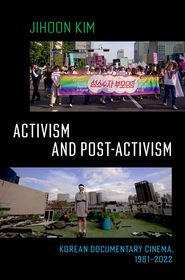
Activism and Post-activism
Korean Documentary Cinema, 1981--2022
- Publisher's listprice GBP 91.00
-
41 086 Ft (39 130 Ft + 5% VAT)
The price is estimated because at the time of ordering we do not know what conversion rates will apply to HUF / product currency when the book arrives. In case HUF is weaker, the price increases slightly, in case HUF is stronger, the price goes lower slightly.
- Discount 10% (cc. 4 108 Ft off)
- Discounted price 36 978 Ft (35 217 Ft + 5% VAT)
Subcribe now and take benefit of a favourable price.
Subscribe
41 086 Ft

Availability
printed on demand
Why don't you give exact delivery time?
Delivery time is estimated on our previous experiences. We give estimations only, because we order from outside Hungary, and the delivery time mainly depends on how quickly the publisher supplies the book. Faster or slower deliveries both happen, but we do our best to supply as quickly as possible.
Product details:
- Publisher OUP USA
- Date of Publication 22 March 2024
- ISBN 9780197760413
- Binding Hardback
- No. of pages328 pages
- Size 156x235x25 mm
- Weight 594 g
- Language English
- Illustrations 22 figures, 1 table 472
Categories
Short description:
Activism and Post-activism: Korean Documentary Cinema, 1981--2022 is a new book about South Korean cinema in the private and independent sectors from the early 1980s to the present day. Drawing on the methodologies of documentary studies, Korean studies, and local documentary discourse, author Jihoon Kim argues that what is unique about this forty-year history of South Korean documentary cinema is the intensive and compressed coevolution of activism aspiring to advocate democracy, progressiveness, and equality through alternative media, and post-activist experiments in documentary forms and aesthetics in the service of renewing the activist tradition.
MoreLong description:
Activism and Post-activism: Korean Documentary Cinema, 1981--2022 is a new book about nonfiction filmmaking in the private and independent sectors of South Korean cinema and media from the early 1980s to the present day. Drawing on the methodologies of documentary studies, experimental film and video, digital cinema, local discourses on independent documentary, and the literature on the social changes of South Korea, author Jihoon Kim historicizes the formation and development of Korean independent documentary in close dialogue with South Korea's social movements. From the 1980s mass anti-dictatorship movement to twenty-first-century labor issues, feminism, LGBT rights, environmental justice, and key events such as the Sewol Ferry disaster and the Candlelight Protests, Kim offers a comprehensive history of Korean social change documentaries in terms of their activist tradition.
At the same time, Kim also maps out the formal and aesthetic divergences of twenty-first-century Korean documentary cinema beyond the activist tradition, while also demonstrating how they have inherited and dynamically renewed the tradition's engagement with contested reality and history. Making the tripartite connections between the socio-political history of South Korea, documentary's aesthetics and politics, and the shifting institutional and technological evolution of documentary production and distribution, the book argues that what is unique about this forty-year history of South Korean documentary cinema is the intensive and compressed coevolution of its two interlocked tendencies: activism and post-activism.
What an impressive achievement! Kim's book is the perfect place to learn about the progressive wing of Korean documentary over the last forty years. The activist and post-activist documentaries that he examines tell the story of resistance and confrontation by workers, women, gays and lesbians, and many other exploited or oppressed groups, on the one hand, and both corporations and the state, on the other. Kim achieves an impeccable balance as he analyzes the interdependency of form and content in films that tackle issues from 'comfort women' in World War II to environmental activism more recently. Told with clarity and verve, this is a probing and perceptive account that amounts to an encyclopaedic analysis of the properties and values of a vast array of documentaries.
Table of Contents:
Acknowledgments
Notes on Romanization and Translations
Introduction: The Double Helix
Part I: Activism
1. The Development of the Activist Tradition in the 1980s and 1990s
2. 21st-Century Activist Documentaries: Three Traditional Issues
3. New Social Movements and Alternative Media Practices
Part II: Post-Activism
4. The Personal Turn: Domestic Ethnography, the Essay Film, Reenactment
5. The Audiovisual Turn: From hyonjang to Memoryscape
6. The Archival Turn: Memory Wars and Materialist Historiography
7. The Digital Turn: Seeking Truth Differently
Epilogue
Notes
Index

