

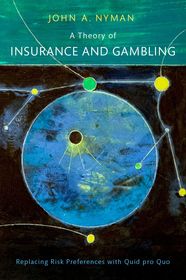
A Theory of Insurance and Gambling
Replacing Risk Preferences with Quid pro Quo
- Publisher's listprice GBP 62.00
-
27 993 Ft (26 660 Ft + 5% VAT)
The price is estimated because at the time of ordering we do not know what conversion rates will apply to HUF / product currency when the book arrives. In case HUF is weaker, the price increases slightly, in case HUF is stronger, the price goes lower slightly.
- Discount 10% (cc. 2 799 Ft off)
- Discounted price 25 194 Ft (23 994 Ft + 5% VAT)
Subcribe now and take benefit of a favourable price.
Subscribe
27 993 Ft

Availability
Estimated delivery time: In stock at the publisher, but not at Prospero's office. Delivery time approx. 3-5 weeks.
Not in stock at Prospero.
Why don't you give exact delivery time?
Delivery time is estimated on our previous experiences. We give estimations only, because we order from outside Hungary, and the delivery time mainly depends on how quickly the publisher supplies the book. Faster or slower deliveries both happen, but we do our best to supply as quickly as possible.
Product details:
- Publisher OUP USA
- Date of Publication 22 March 2024
- ISBN 9780197687925
- Binding Hardback
- No. of pages272 pages
- Size 163x226x35 mm
- Weight 499 g
- Language English 472
Categories
Short description:
In 1948, Milton Friedman and L. J. Savage suggested that risk preferences explain the demand for insurance and gambling--a theory that is still almost universally accepted by economists today. In A Theory of Insurance and Gambling, John A. Nyman critiques this approach and proposes a new theory of the motivations for insurance and gambling. Nyman seeks to reorient how economists think about insurance and gambling by moving away from uncertainty as a negative motivating factor to simply a mechanical feature that allows for the augmentation of income and consumption, by moving away from biased models that ignore income effects and state dependency in evaluating the benefits from insurance and gambling, and by moving away from preferences regarding risk toward the desire to obtain additional future income.
MoreLong description:
In 1948, Milton Friedman and L. J. Savage suggested that risk preferences explain the demand for insurance and gambling--a theory that is still almost universally accepted by economists today. If you were to ask almost any economist why people purchase insurance, they would say it is because most people are "risk averse," or equivalently, "prefer certainty of losses." If asked to explain why people gamble, they would say it is because some people are "risk seekers."
In A Theory of Insurance and Gambling, John A. Nyman critiques this approach and proposes a new theory of the motivations for insurance and gambling. He argues that demand for insurance and gambling is best understood by focusing not on risk preferences, but on the income transfer, the states of the world that trigger the income transfer, and the value of the income in those states. In other words, insurance is motivated by a preference to transfer income to future states of the world where income is more valuable. Gambling, on the other hand, is motivated by a preference to transfer income to future states of the world where additional income is less costly to obtain.
Nyman ultimately seeks to reorient how economists think about insurance and gambling by moving away from seeing uncertainty as a negative motivating factor to simply a mechanical feature that allows for the augmentation of income and consumption. He moves away from biased models that ignore income effects and state dependency when evaluating the benefits from insurance and gambling, and away from preferences regarding risk toward the desire to obtain additional future income. Presenting the case that risk preferences do not motivate demand for insurance or gambling, A Theory of Insurance and Gambling calls into question a fundamental tenet of economic thinking.
Why do we insure...and gamble? John Nyman has a novel and compelling perspective. Forget risk; think about what influences the value of income. The implications are wider and deeper than you might expect. This is an important contribution.
Table of Contents:
Preface
1. Introduction
2. Demand for Insurance: Preference for Certainty or Desire for Additional Income
3. Demand for Gambling: Preference for Risk or Desire for Work-free Income
4. Insurance and Gambling Supply
5. Evidence on Risk Preferences and the Role of Prospect Theory in Insurance
6. The Role of Loss Aversion in Insurance
7. Empirical Evidence for Gambling
8. Price and Income Effects in Insurance
9. The Insurance-purchasing Gambler
10. Conclusions
References
Index

