

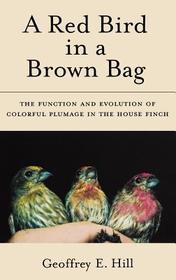
A Red Bird in a Brown Bag
The Function and Evolution of Colorful Plumage in the House Finch
Series: Oxford Ornithology Series;
- Publisher's listprice GBP 63.00
-
30 098 Ft (28 665 Ft + 5% VAT)
The price is estimated because at the time of ordering we do not know what conversion rates will apply to HUF / product currency when the book arrives. In case HUF is weaker, the price increases slightly, in case HUF is stronger, the price goes lower slightly.
- Discount 10% (cc. 3 010 Ft off)
- Discounted price 27 088 Ft (25 799 Ft + 5% VAT)
Subcribe now and take benefit of a favourable price.
Subscribe
30 098 Ft

Availability
printed on demand
Why don't you give exact delivery time?
Delivery time is estimated on our previous experiences. We give estimations only, because we order from outside Hungary, and the delivery time mainly depends on how quickly the publisher supplies the book. Faster or slower deliveries both happen, but we do our best to supply as quickly as possible.
Product details:
- Publisher OUP USA
- Date of Publication 17 October 2002
- ISBN 9780195148480
- Binding Hardback
- No. of pages336 pages
- Size 242x163x20 mm
- Weight 594 g
- Language English
- Illustrations 3 halftones & numerous line figures 0
Categories
Short description:
This book is an uncommonly engaging study on the evolution of sexual selection in birds, as addressed through a particularly well developed research program by a superb ornitholoigst, with good credibility also in the evolutionary biology community. The book also gives an engaging portrait of the challenges and constraints of experimental design facing any field investigator working with animal behaviour. Hill's book should serve as a model for a focused scholarly book with broader potential appeal, and it should sell very well to ornithologists and serious amateurs, and also to evolutionary biologists and behavioural ecologists.
MoreLong description:
This is an account of studies of the function and evolution of colorful plumage in the House Finch. It is also an engaging study on the evolution of sexual selection in birds and a lively portrait of the challenges and constraints of experimental design facing any field investigator working with animal behavior. Part I sets the stage for modern studies of the function of plumage coloration with a review of the nineteenth and beginning of the twentieth centuries. Part II focuses on the proximate control and present function of plumage coloration. Part III takes a more explicitly evolutionary approach to the study of plumage coloration using biogeography and phylogeny to test hypotheses for why specific forms of plumage color display have evolved. It concludes with an account of comparative studies that have been conducted in the House Finch and other cardueline finches and the insight these studies have provided on the evolution of carotenoid-based ornamental coloration.
Hill's book is, thus far, probably the most complete study of the function and control of plumage pigmentation in a single bird species. It was an easy read because of Hill's ability to write clearly and creatively, and to present ideas in a logical order.
Table of Contents:
Part 1: Prelude
Darwinism and Wallacism: A Brief Account of the Long History of the Study of Plumage Coloration
A Red Bird in a Brown Bag: An Introduction to the House Finch
In the Eye of the Beholder: Color Vision and the Quantification of Colour
Part 2: The Proximate Control and Function of Red Plumage
You Are What You Eat: Plumage Pigments and Carotenoid Physiology
A Matter of Condition: The Effect of Environment on Plumage Coloration
Darwin Vindicated: Female Choice and Sexual Selection in the House Finch
Fine Fathers and Good Genes: The Direct and Indirect benefits of female choice
Studs, Duds, and Studly Duds: Plumage Coloration, Hormones, and Dominance
The Feeling's Mutual: Female Plumage Coloration and Male Mate Choice
Part 3: Biogeography and the Evolution of Colorful Plumage
From the Halls of Montezuma, to the Shores of Tripoli (New York): Populations, Subspecies, and Geographic Variation in Ornamental Coloration
Why Red?: The Evolution of Color Display
Epilogue
Glossary

