

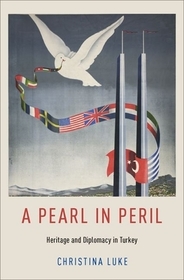
A Pearl in Peril
Heritage and Diplomacy in Turkey
- Publisher's listprice GBP 95.00
-
42 892 Ft (40 850 Ft + 5% VAT)
The price is estimated because at the time of ordering we do not know what conversion rates will apply to HUF / product currency when the book arrives. In case HUF is weaker, the price increases slightly, in case HUF is stronger, the price goes lower slightly.
- Discount 10% (cc. 4 289 Ft off)
- Discounted price 38 603 Ft (36 765 Ft + 5% VAT)
Subcribe now and take benefit of a favourable price.
Subscribe
42 892 Ft

Availability
Estimated delivery time: In stock at the publisher, but not at Prospero's office. Delivery time approx. 3-5 weeks.
Not in stock at Prospero.
Why don't you give exact delivery time?
Delivery time is estimated on our previous experiences. We give estimations only, because we order from outside Hungary, and the delivery time mainly depends on how quickly the publisher supplies the book. Faster or slower deliveries both happen, but we do our best to supply as quickly as possible.
Product details:
- Publisher OUP USA
- Date of Publication 7 February 2019
- ISBN 9780190498870
- Binding Hardback
- No. of pages288 pages
- Size 163x239x27 mm
- Weight 590 g
- Language English
- Illustrations 53 halftones and 4 line art illustrations 0
Categories
Short description:
A Pearl in Peril investigates the intersection of diplomacy and heritage in Turkey. American, and European approaches to assistance are explored through the lens of the 1919 Paris Peace Conference, the League of Nations, and UNESCO's promise.
MoreLong description:
Known as "the Pearl of the Mediterranean," Izmir invokes a city and countryside blessed with good fortune; it is known to many as the homeland of Ephesus, Bergama, and Sardis. Yet, Turkey's third largest city has an especially vexed past. The Greek pursuit of the Megali Idea leveraged Classical history for 19th century political gains, and in so doing also foreshadowed the "Asia Minor Catastrophe." Princeton University's work at Sardis played into the duplicitous agendas of western archaeologists, learned societies, and diplomats seeking to structure heritage policy and international regulations in their favor, from the 1919 Paris Peace Conference to the League of Nations. A Pearl in Peril reveals the voices of those on the ground. It also explores how Howard Crosby Butler, William Hepburn Buckler, and William Berry penetrated the inner circle of world leaders, including Woodrow Wilson, Lloyd George, and Eleftherios Venizelos.
On the smoldering ashes of Anatolia's scorched earth, foreign intervention continued apace with plans for large-scale development. A Pearl in Peril tackles the untold story of Julian Huxley's admiration of the US Tennessee Valley Authority's "principals of persuasion" in the context of the industrial landscapes and pursuit of modernity in the Aegean. The promise of UNESCO, too, brought diplomacy dollars deployed to foster "mutual understanding" through preservation programs at Sardis. Yet, from this same pot of money came support for "open intelligence" at the international fairs held in Izmir's Kültürpark, a turnkey battleground of the Cold War. Ironically, it was UNESCO's colossal Abu Simbel project in Egypt that led the US to abandon their preservation initiatives in Turkey. Five decades on, groves of organic olives, marble quarries and gold mines not only threaten the erasure of sacred landscapes, but also ensure the livelihood of local communities. Ultimately, A Pearl in Peril offers a bold assessment of diplomatic practice, perspectives of contemporary heritage, and the challenges of unprecedented expansion of city and countryside.
Christina Luke's timely book on the struggles of cultural and natural heritage preservation and the challenges of conducting research-driven archaeological work also reveals a broader story of heritage, capitalism and world politics in the last century....This excellent and scholarly book sets a high standard in research and presentation. It will be of use and interest to all those interested in the cultural history of the Middle East.
Table of Contents:
Acknowledgements
Abbreviations
Foreword
Introduction: Pillars of Policy
Chapter 1: Alternative Futures
Chapter 2: Preference in Paris
Chapter 3: Open Intelligence
Chapter 4: Diplomatic Deliverables
Chapter 5: Organic Lives
Reflections
Notes
Bibliography
Index

