

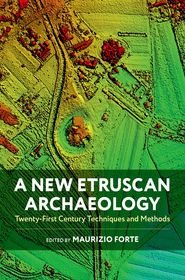
A New Etruscan Archaeology
Twenty-First Century Techniques and Methods
- Publisher's listprice GBP 64.00
-
28 896 Ft (27 520 Ft + 5% VAT)
The price is estimated because at the time of ordering we do not know what conversion rates will apply to HUF / product currency when the book arrives. In case HUF is weaker, the price increases slightly, in case HUF is stronger, the price goes lower slightly.
- Discount 10% (cc. 2 890 Ft off)
- Discounted price 26 006 Ft (24 768 Ft + 5% VAT)
Subcribe now and take benefit of a favourable price.
Subscribe
28 896 Ft

Availability
printed on demand
Why don't you give exact delivery time?
Delivery time is estimated on our previous experiences. We give estimations only, because we order from outside Hungary, and the delivery time mainly depends on how quickly the publisher supplies the book. Faster or slower deliveries both happen, but we do our best to supply as quickly as possible.
Product details:
- Publisher OUP USA
- Date of Publication 30 October 2025
- ISBN 9780197582022
- Binding Hardback
- No. of pages256 pages
- Size 240x167x24 mm
- Weight 531 g
- Language English
- Illustrations 76, b/w 625
Categories
Short description:
A New Etruscan Archaeology provides a comprehensive overview of the latest advancements in archaeological methods and technologies applied to the study of Etruscan civilization. Through vivid illustrations, detailed case studies, and research from twenty-five experts, this book emphasizes the synergy between archaeology and technology. Each chapter illustrates how the integration of digital technologies--such as remote sensing, high resolution 3D imaging, electroencephalography (EEG), and artificial intelligence--can push the field into a new era of innovation and multidisciplinary collaboration.
MoreLong description:
A New Etruscan Archaeology provides a comprehensive overview of the latest advancements in archaeological methods and technologies applied to the study of Etruscan civilization. Through vivid illustrations, detailed case studies, and research from twenty-five experts, this book emphasizes the synergy between archaeology and technology. Each chapter illustrates how the integration of digital technologies--such as remote sensing, high resolution 3D imaging, electroencephalography (EEG), and artificial intelligence--can push the field into a new era of innovation and multidisciplinary collaboration.
The volume begins with an exploration of digital technologies used for studying inscriptions, enhancing both accuracy and context, while addressing key epistemological issues. It then delves into urban landscape surveys, highlighting how remote sensing and spatial analysis revolutionize our understanding of Etruscan cityscapes and infrastructures. Advanced remote sensing technologies like ground-penetrating radar (GPR), LiDAR, and magnetometry are showcased for their ability to provide comprehensive data about Etruscan sites.
Cognitive archaeology is explored, particularly the acoustic properties of Etruscan tombs and their implications for understanding funerary rituals, to offer a new perspective on Etruscan cultural practices. Readers are also shown how nanosilica, among other modern materials and advanced techniques, might be used in future conservation practices.
Contributors highlight how environmental and paleoenvironmental studies have provided researchers with a more nuanced understanding of how Etruscans interacted with their landscape and managed their resources. The result is an extensive examination of the ways that science has been used--or might potentially be used in the future--to help us map ancient cities, reconstruct lost artifacts, and even decode the Etruscan language, bringing the past to life with unparalleled clarity and precision.
Table of Contents:
To come
More
