

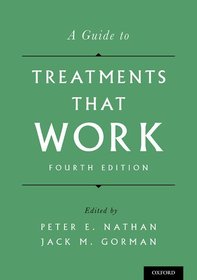
A Guide to Treatments That Work
- Publisher's listprice GBP 172.50
-
82 411 Ft (78 487 Ft + 5% VAT)
The price is estimated because at the time of ordering we do not know what conversion rates will apply to HUF / product currency when the book arrives. In case HUF is weaker, the price increases slightly, in case HUF is stronger, the price goes lower slightly.
- Discount 10% (cc. 8 241 Ft off)
- Discounted price 74 170 Ft (70 638 Ft + 5% VAT)
Subcribe now and take benefit of a favourable price.
Subscribe
82 411 Ft

Availability
printed on demand
Why don't you give exact delivery time?
Delivery time is estimated on our previous experiences. We give estimations only, because we order from outside Hungary, and the delivery time mainly depends on how quickly the publisher supplies the book. Faster or slower deliveries both happen, but we do our best to supply as quickly as possible.
Product details:
- Edition number 4
- Publisher OUP USA
- Date of Publication 20 August 2015
- ISBN 9780199342211
- Binding Hardback
- No. of pages988 pages
- Size 254x191x55 mm
- Weight 1882 g
- Language English 0
Categories
Short description:
Like its predecessors, this fourth edition of A Guide to Treatments That Work offers detailed chapters that review the latest research on pharmacological and psychosocial treatments that work for the full range of psychiatric and psychological disorders.
MoreLong description:
Like its predecessors, this fourth edition of A Guide to Treatments That Work offers detailed chapters that review the latest research on pharmacological and psychosocial treatments that work for the full range of psychiatric and psychological disorders, written in most instances by clinical psychologists and psychiatrists who have been major contributors to that literature. Similarly, the standards by which the authors were asked to evaluate the methodological rigor of the research on treatments have also remained the same.
Each chapter in A Guide to Treatments That Work follows the same general outline: a review of diagnostic cues to the disorder, a discussion of changes in the nomenclatures from DSM-IV to DSM-5, and then a systematic review of research, most of which has been reported within the last few years, that represents the evidence base for the treatments reviewed. In all, 26 of the volume's 28 chapters review the evidence base for 17 major syndromes. Featuring this coverage is a Summary of Treatments that Work, an extended matrix offering a ready reference by syndrome of the conclusions reached by the chapter authors on treatments that work reviewed in their chapters. New to this edition are two chapters at the beginning of the book. Chapter 1 details two perplexing issues raised by critics of DSM-5: the unrealized potential of neuroscience biomarkers to yield more accurate and reliable diagnoses and the lingering problem of conflicts of interest in pharmaceutical research. Chapter 2 contrasts Native American and western ways of identifying effective treatments for mental and physical disorders, concluding that "evidence-informed culture-based" interventions sometimes constitute best practices in Native communities. Two chapters detailing pharmacological treatments for pediatric bipolar disorder (Chapter 9) and pediatric depressive disorder (Chapter 12) have also been added. More than three quarters of the chapters are written by colleagues who also contributed to most or all of the previous editions. Hence, this new edition provides up-to-date information on the quality of research on treatment efficacy and effectiveness provided by individuals who know the research best.
It is remarkably thorough without being overwhelming. The information is readily accessible and is useful for clinicians who are referring to it briefly, or opening it to brush up on the literature in a given area. But this book's main strength is that the authors also are using an evidence-based approach to psychotherapy for many major psychiatric conditions, an area many clinicians unfortunately neglect in their treatment recommendations. This is a worthy effort and one book likely to be used over and over, not accumulating dust on a shelf.
Table of Contents:
Preface
Contents
Contributors
Summary of Treatments that Work
1. Challenges to Implementing Evidence-Based Treatments
Jack M. Gorman & Peter E. Nathan
2. Evidence-Informed, Culture-Based Interventions and Best Practices in American Indian and Alaska Native Communities
R. Dale Walker & Douglas A. Bigelow
3. Nonpharmacological Treatments for Childhood ADHD and their Combination with
Medication
Linda J. Pfiffner & Lauren M. Haack
4. Pharmacological Treatments for Attention-Deficit/Hyperactivity Disorder and
Disruptive Behavior Disorders
Erica Kass, Jonathan Posner, & Laurence L. Greenhill
5. Psychosocial Treatments for Conduct Disorder in Children and Adolescents
Alan E. Kazdin
6. Pharmacological Treatments for Schizophrenia
Athier Abbas & Jeffrey Lieberman
7. Cognitive and Social Cognitive Interventions for Schizophrenia
Matthew M. Kurtz
8. Pharmacological Treatments for Bipolar Disorder
Paul E. Keck, Jr., & Susan L. McElroy
9. Treatments for Pediatric Bipolar Disorder
Pablo Goldberg, Prerna Martin, Carolina Bieracki, & Moira Rynn
10. Psychosocial Treatments for Bipolar Disorder
Anjana Muralidharan, David J. Miklowitz, & W. Edward Craighead
11. Pharmacological Treatments for Unipolar Depression
Stefania Prendes-Alvarez, Alan F. Schatzberg, & Charles B. Nemeroff
12. Treatments for Pediatric Depression
Carolina Biernacki, Prerna Martin, Pablo Goldberg, & Moira Rynn
13. Psychosocial Treatments for Major Depressive Disorder
W. Edward Craighead, Benjamin N. Johnson, Sean Carey, & Broadie
W. Dunlop
14. Psychological Treatments for Panic Disorders, Phobias, and Social and Generalized
Anxiety Disorders
David H. Barlow, Laren R. Conklin, & Kate H. Bentley
15. Pharmacological Treatments for Panic Disorder, Generalized Anxiety Disorder, Specific
Phobia, and Social Anxiety Disorder
Ryan J. Kimmel, Peter P. Roy-Byrne, & Deborah S. Cowley
16. Combination Pharmacotherapy and Psychotherapy for the Treatment of Major
Depressive and Anxiety Disorders
Cindy J. Aaronson, Gary Katzman & Rachel L. Moster
17. Treatments for Obsessive-Compulsive Disorder
Darin D. Dougherty, Scott L. Rauch, & Michael A. Jenike
18. Psychosocial Treatments for Posttraumatic Stress Disorder
Lisa M. Najavits & Melissa L. Anderson
19. Pharmacological Treatment of Posttraumatic Stress Disorder
Julia A. Golier, Andreas C. Michaelides, Maya Genovesi, Emily Chapman, & Rachel
Yehuda
20. Treatments for Eating Disorders
Kathleen M. Pike, Loren M. Gianini, Katharine L. Loeb, & Daniel Le Grange
21. Treatment of Sleep Disorders
Deepa Burman, Daniel J. Buysse, & Charles F. Reynolds, III
22. Pharmacotherapy and Psychotherapy for Sexual Dysfunctions
R. Taylor Segraves
23. Psychosocial Treatments for Substance Use Disorders
Daniel M. Blonigen, John W. Finney, Paula L. Wilbourne, & Rudolf H. Moos
24. Psychopharmacological Treatments for Substance Use Disorders
James R. McKay, Henry R. Kranzler, Kyle M. Kampman, Rebecca L. Ashare, & Robert A. Schnoll
25. Treatments for Gambling Disorder and Impulse Control Disorders
Jon E. Grant, Brian L. Odlaug, & Marc N. Potenza
26. Treatments for Neurocognitive Disorders
Pei Huey Nie & David L. Sultzer
27. Psychological Treatments for Personality Disorders
Paul Crits-Christoph & Jacques P. Barber
28. Psychopharmacological Treatment of Personality Disorders
M. Mercedes Perez-Rodriguez & Larry J. Siever

