

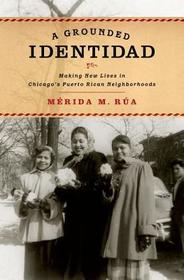
A Grounded Identidad
Making New Lives in Chicago's Puerto Rican Neighborhoods
- Publisher's listprice GBP 79.00
-
37 742 Ft (35 945 Ft + 5% VAT)
The price is estimated because at the time of ordering we do not know what conversion rates will apply to HUF / product currency when the book arrives. In case HUF is weaker, the price increases slightly, in case HUF is stronger, the price goes lower slightly.
- Discount 10% (cc. 3 774 Ft off)
- Discounted price 33 968 Ft (32 351 Ft + 5% VAT)
Subcribe now and take benefit of a favourable price.
Subscribe
37 742 Ft

Availability
printed on demand
Why don't you give exact delivery time?
Delivery time is estimated on our previous experiences. We give estimations only, because we order from outside Hungary, and the delivery time mainly depends on how quickly the publisher supplies the book. Faster or slower deliveries both happen, but we do our best to supply as quickly as possible.
Product details:
- Publisher OUP USA
- Date of Publication 13 September 2012
- ISBN 9780199760268
- Binding Hardback
- No. of pages256 pages
- Size 224x147x15 mm
- Weight 340 g
- Language English
- Illustrations 16 b/w halftones, 2 maps 0
Categories
Short description:
This interdisciplinary study--the first book-length study of Chicago's Puerto Rican community rooted not simply in contemporary ethnographic source material but also in extensive historical research--shows the varied ways Puerto Ricans came to understand their identities and rights within and beyond the city they made home.
MoreLong description:
Chicago is the home to the third-largest concentration of Puerto Ricans in the United States, but scholarship on the city rarely accounts for Puerto Ricans. This book is part of a revisionary effort to include Puerto Ricans in the history of Chicago. Rúa explores the multiple meanings of latinidad (a shared sense of identity among people of Latin American and Caribbean descent) from a historical and ethnographic perspective by examining daily lives. She shows that Puerto Ricans in Chicago have continually constructed, restructured, and transformed place through discourses and experiences of rejection and belonging, despair and hope.
Rúa traces Puerto Ricans' construction of identity in a narrative that begins in 1945, when a small group of University of Puerto Rico graduates earned scholarships to attend the University of Chicago as a private employment agency recruited Puerto Rican domestics and foundry workers. These people formed the foundation of Chicago's contemporary Puerto Rican community. In the following six decades, Chicago witnessed urban renewal, loss of neighborhoods, emergence of multiracial coalitions, waves of protest movements, and celebrations of life within which Puerto Ricans negotiated their identity, as Puerto Ricans, as Latinos, and as U.S. citizens.
Puerto Ricans arriving in the U.S. had come from an island colony, but they had had the status of U.S. citizens, and most considered themselves, and were considered to be, "white." And yet, their brownness was considered "colored," and their citizenship was second class. They seemed to share few of the rights other Chicagoans took for granted. Memory and place and loss and identity seemed interconnected. Were those of Puerto Rican descent historical anomalies of the vestiges of empire? Or genuine American citizens? What is the link for Puerto Ricans, other than the Spanish language, to other Latinos, citizens as well as undocumented migrants and documented ones?
Through a variety of sources, including oral history interviews, ethnographic observations, archival research, and textual criticism, A Grounded Identidad attempts to redress the oversight of traditional scholarship on Chicago by presenting the example of Puerto Ricans, their reconstruction from colonial subjects to second-class citizens, and the implications of this political reality on how they have been racially imagined and positioned vis-à-vis blacks, whites, and Mexicans over time.
an important contribution to existing studies on Puerto Rican immigration.
Table of Contents:
Prologue: Field Trips and Field Notes: Reflections on Memory and Neighborhoods
Chapter 1: A Female Network of Domestics, Student Allies, and Social Workers
Chapter 2: "Non-Resident Persons," "Nationalists," and the Puerto Ricans of Chicago
Chapter 3: Neighborhood Obituaries, Resilient Communities
Chapter 4: Overlapping Diasporas, Tangled Relations
Chapter 5: Rites of Passage and Personhood
Chapter 6: Communities of Reciprocal Knowledge
Methodology and Sources
Appendix A: Consent Form
Appendix B: Forma de consentimiento
Methodology and Sources
Appendix A: Consent Form
Appendix B: Forma de consentimiento
Appendix C: Preliminary Questions To Be Asked in Formal and Informal Interviews
Appendix D: Preguntas de la entrevista
Notes
Bibliography
Index

