

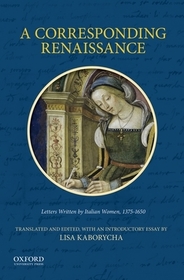
A Corresponding Renaissance
Letters Written by Italian Women
- Publisher's listprice GBP 47.99
-
21 667 Ft (20 635 Ft + 5% VAT)
The price is estimated because at the time of ordering we do not know what conversion rates will apply to HUF / product currency when the book arrives. In case HUF is weaker, the price increases slightly, in case HUF is stronger, the price goes lower slightly.
- Discount 10% (cc. 2 167 Ft off)
- Discounted price 19 500 Ft (18 572 Ft + 5% VAT)
Subcribe now and take benefit of a favourable price.
Subscribe
21 667 Ft

Availability
printed on demand
Why don't you give exact delivery time?
Delivery time is estimated on our previous experiences. We give estimations only, because we order from outside Hungary, and the delivery time mainly depends on how quickly the publisher supplies the book. Faster or slower deliveries both happen, but we do our best to supply as quickly as possible.
Product details:
- Publisher OUP USA
- Date of Publication 9 July 2015
- ISBN 9780199342433
- Binding Paperback
- No. of pages320 pages
- Size 231x155x22 mm
- Weight 408 g
- Language English 0
Categories
Short description:
A Corresponding Renaissance is a sourcebook of fifty-four letters written by Italian Renaissance women, newly translated into English (many for the first time ever).
MoreLong description:
Women's vibrant presence in the Italian Renaissance has long been overlooked, with attention focused mainly on the artistic and intellectual achievements of their male counterparts. During this period, however, Italian women excelled especially as writers, and nowhere were they more expressive than in their letters. In A Corresponding Renaissance: Letters Written by Italian Women, 1375-1650 Lisa Kaborycha considers the lives and cultural contributions revealed by these women in their own words, through their correspondence. By turns highly personal, didactic, or devotional, these letters expose the daily realities of women's lives, their feelings, ideas, and reactions to the complex world in which they lived. Through their letters women emerge not merely as bystanders, but as true cultural protagonists in the Italian Renaissance.
A Corresponding Renaissance is divided into eight thematic chapters, featuring fifty-five letters that are newly translated into English-many for the first time ever. Each of the letters is annotated and includes a brief biographical introduction and bibliographic references. The women come from all walks of life -- saints, poets, courtesans and countesses -- and from every geographic area of Italy; chronologically they span the entire Renaissance, with the majority representing the sixteenth century. Approximately one third of the selections are well-known letters, such as those of Catherine of Siena, Veronica Franco, and Isabella d'Este; the rest are lesser known, previously un-translated, or otherwise inaccessible.
Kaborycha's selections are more than socio-economically and geographically diverse (the letter-writers include saints, heretics and whores, actresses and duchesses from Milan to Naples); they are creative. Kaborycha strikes a graceful balance between canonicity and anonymity.
Table of Contents:
Each chapter ends with Suggestions for Further Reading
Map of Italy showing cities and towns of origin or destination of letters associated with the correspondents
Acknowledgements
About the Editor
Introduction
Chapter One: The Active Versus the Contemplative Life
1. Caterina Benincasa describes the execution of Niccolò di Toldo to Raymond of Capua
2. Brigida Baldinotti praises the women who serve at Florence's S. Maria Nuova hospital
3. Cassandra Fedele responds to Alessandra Scala's request for advice on whether to write or marry
4. Paula Antonia Negri urges Gaspara Stampa to choose the life of the spirit over the worldly life
5. Olympia Fulvia Morata to Caelius Secundus Curio on "giving birth" to her writings
6. Maria Maddalena de' Pazzi sends Christmas nativity scene decorations to her niece Maria
Chapter Two: Humanism and its Discontents
7. Maddalena Scrovegni to Jacopo dal Verme in praise of Giangaleazzo Visconti
8. Isotta Nogarola asks Guarino Guarini why he has not responded to her letter
9. Costanza Varano writes to Isotta Nogarola, praising her learning
10. Nicolosa Castellani Sanuti to Cardinal Bessarion challenging sumptuary laws
11. Laura Cereta to Agostino Emilio condemning women's excessive luxury in dress
Chapter Three: Governing the Household/Governing the State
12. Margherita Datini criticizes her husband Francesco Datini for his handling of business matters and worries about his health
13. Lucrezia Tornabuoni reports her impressions of a prospective bride for their son to husband Pietro de' Medici
14. Eleonora D'Aragona complains to husband Ercole d'Este about his soldiers' unbridled violence
15. Guglielmina Schianteschi informs her husband Luigi della Stufa of her management of country property and urges him to economize
16. Lucrezia Borgia warns her father Pope Alexander VI Borgia to leave Rome
17. Maria Salviati tells Giovanni [?] of her determination not to re-marry
18. Caterina de' Ricci advises her father Pierfrancesco de' Ricci to resolve a family quarrel
Chapter Four: Mothers and Children
19. Pandolfina Baglioni expresses her desire to see her mother, Pantasilea Salimbene
20. Alessandra Macinghi Strozzi to her son Filippo Strozzi on taking precautions against illness and death
21. Lucrezia (Nannina) de' Medici confides in her mother Lucrezia Tornabuoni about a marital disagreement
22. Caterina Sforza warns her son Ottaviano Riario to maintain secrecy and beware of enemies
23. Cassandra Chigi discusses household needs and shopping with her mother Sulpizia Petrucci
24. Veronica Franco reproves a woman who wants to train her daughter as a courtesan
25. Isabella Andreini congratulates a man on the birth of a daughter
Chapter Five: Love and Friendship
26. Camilla Pisana complains to Francesco del Nero about her lover, Filippo Strozzi
27. Maria Savorgnan to Pietro Bembo expressing the depth of her love for him
28. Cecilia Liconella expresses her love to Nicolò de Lazara, a noble she met in Padua
29. Marietta Corsini describes their newborn son to her husband Niccolò Machiavelli
30. Vittoria Colonna explains her silence to Michelangelo Buonarroti
31. Ginevra Gozzadini requests marital advice from her spiritual advisor, Leone Bartolini
32. Celia Romana describes amusements of Roman Carnival season and expresses distress at her lover's neglect
33. Emilia N. Fiorentina returns her lover's letters but asks him to publish his love poems
34. Margherita Costa imagines a love letter written by a beautiful woman to a dwarf
Chapter Six: Literature and Leisure
35. Bartolomea degli Obizzi Alberti discusses theories of reading to a female friend
36. Ippolita Maria Sforza describes her impressions as a newlywed at the Aragonese court to her mother Bianca Maria Visconti
37. Tullia d'Aragona asks Benedetto Varchi's aid in drafting a letter to Duke Cosimo I de' Medici and Duchess Eleonora di Toledo
38. Laura Battiferra dedicates her book of poetry to Eleonora di Toledo, Duchess of Florence
39. Vittoria Archilei laments her declining singing career and asks the Grand Duchess Christine to assist her son
40. Francesca Caccini requests a libretto for her new composition from Michelangelo Buonarroti the Younger
41. Arcangela Tarabotti thanks friar Giovanni Battista Fusconi for his musical drama
Chapter Seven Art: Patrons and Painters
42. Isabella d'Este proposes a subject for a painting to Leonardo da Vinci
43. Veronica Gambara recommends a work of the painter Correggio to Isabella d'Este
44. Cornelia Colonello appeals to Michelangelo Buonarroti in a legal dispute with her father
45. Margherita Aratori expresses to Costanza Colonna how she misses her
46. Sofonisba Anguissola asks Philip II of Spain for a recommendation for her husband
47. Lavinia Fontana to Alfonso Ciacòn sending a self-portrait that he had requested
48. Artemisia Gentileschi discusses costs and terms of payment for her paintings with Don Antonio Ruffo
Suggestions for further reading
Chapter Eight: Inquiring minds: Science and Philosophy
49. Ceccarella Minutolo to Theophilo on how knowledge is acquired and transmitted
50. Chiara Matraini to Maria Cardonia on the superiority of philosophy to military "science"
51. Margherita Sarrocchi confirms Galileo's astronomical observations to Guido Bettoli
52. Camilla Erculiani Greghetti explains her theory of the interaction of physical elements at the time of the Biblical Flood to Márton Berzeviczy
53. Sara Copio Sullam discusses philosophical and theological views on human mortality with Baldassarre Bonifacio
54.Virginia Galilei sends for linens and requests a copy of The Assayer from her father Galileo Galilei
55. Elena Lucrezia Corner Piscopia asks university director Nicolò Venier to restore her mentor's tenure
Suggestions for further reading
Selected Bibliography
Credits
Index

