

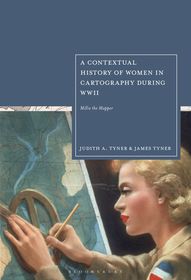
A Contextual History of Women in Cartography During WWII
Millie the Mapper
- Publisher's listprice GBP 90.00
-
40 635 Ft (38 700 Ft + 5% VAT)
The price is estimated because at the time of ordering we do not know what conversion rates will apply to HUF / product currency when the book arrives. In case HUF is weaker, the price increases slightly, in case HUF is stronger, the price goes lower slightly.
- Discount 18% (cc. 7 314 Ft off)
- Discounted price 33 321 Ft (31 734 Ft + 5% VAT)
- Discount is valid until: 5 August 2026
Subcribe now and take benefit of a favourable price.
Subscribe
33 321 Ft

Availability
Not yet published.
Why don't you give exact delivery time?
Delivery time is estimated on our previous experiences. We give estimations only, because we order from outside Hungary, and the delivery time mainly depends on how quickly the publisher supplies the book. Faster or slower deliveries both happen, but we do our best to supply as quickly as possible.
Product details:
- Publisher Bloomsbury Publishing (UK)
- Date of Publication 3 September 2026
- ISBN 9781666919998
- Binding Hardback
- No. of pages184 pages
- Size 228.6x152.4 mm
- Language English
- Illustrations 20 bw illus 700
Categories
Short description:
Judith Tyner examines the essential role of women in cartography during WWII.
MoreLong description:
This book examines the essential role of women in cartography during WWII. Starting by highlighting the process of mapping during World War II and major employers of women cartographers, Tyner and Tyner illuminate how the discipline of cartography emerged and highlight the contributions of women involved in this process. The book uncovers the impact of WWII on mapmaking.
Before the war, cartography was seen as a tool rather than a discipline in its own right. The advent of war dramatically changed the cartographic profession and, in turn, contributed to a reimagining of cartography as a discipline. New agencies such as the Army Map Service and the Office of Strategic Services, as well as established agencies such as the U.S. Coast and Geodetic Survey, the Tennessee Valley Authority, and the United States Geological Survey were commissioned to make maps for the war effort. Furthermore, the Army Map Service was the largest employer of women during the War. Overall, this inspiring book looks at the kinds of maps that women made and the attitudes towards women in cartography to tell the untold story of women cartographers during WWII.
Table of Contents:
Introduction
1. Prelude to War
2. Military Mapping Maidens of the Army Map Service
3. Oh So Secret, Women Mapmakers of the Office of Special Services
4. Tennessee Valley Girls
5. Wars Are Fought with Maps, Other government mapping
6. Buy a Map
7. When Johnny Came Marching Home
Conclusion
Appendix
References
Index

