

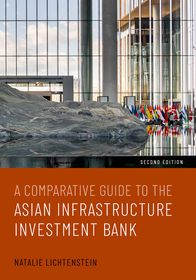
A Comparative Guide to the Asian Infrastructure Investment Bank
- Publisher's listprice GBP 105.00
-
50 163 Ft (47 775 Ft + 5% VAT)
The price is estimated because at the time of ordering we do not know what conversion rates will apply to HUF / product currency when the book arrives. In case HUF is weaker, the price increases slightly, in case HUF is stronger, the price goes lower slightly.
- Discount 10% (cc. 5 016 Ft off)
- Discounted price 45 147 Ft (42 998 Ft + 5% VAT)
Subcribe now and take benefit of a favourable price.
Subscribe
50 163 Ft

Availability
Estimated delivery time: In stock at the publisher, but not at Prospero's office. Delivery time approx. 3-5 weeks.
Not in stock at Prospero.
Why don't you give exact delivery time?
Delivery time is estimated on our previous experiences. We give estimations only, because we order from outside Hungary, and the delivery time mainly depends on how quickly the publisher supplies the book. Faster or slower deliveries both happen, but we do our best to supply as quickly as possible.
Product details:
- Edition number 2
- Publisher OUP USA
- Date of Publication 3 March 2026
- ISBN 9780197823088
- Binding Hardback
- No. of pages344 pages
- Size 256x188x30 mm
- Weight 798 g
- Language English 692
Categories
Short description:
A Comparative Guide to the Asian Infrastructure Investment Bank (AIIB) is the definitive resource on the US$100 billion multilateral development bank launched by China in 2015 to finance infrastructure across Asia and beyond. Written by the lawyer who helped draft the AIIB Charter, the book offers rare insight into the Bank's legal foundations and evolution. This updated 2025 edition includes new research on the World Bank's origins and a review of AIIB's first decade of innovation in global development finance.
MoreLong description:
The Asian Infrastructure Investment Bank (AIIB) opened in 2016, as a US$100 billion multilateral development bank (MDB) financing public and private infrastructure projects for Asia. AIIB's investments in its first ten years totalled more than US$60 billion. Among its 110 approved members are countries in Asia and Oceania, Europe, Africa, and the Americas.
In addition to highlighting key innovations from AIIB's first ten years in operation, the second edition of A Comparative Guide to the Asian Infrastructure Investment Bank examines AIIB through the lens of its Charter, focusing on its mandate, investment operations, membership, finance, governance framework and decision-making, and institutional setup. Why these elements matter for MDBs is explained, followed by analysis of the AIIB Charter text, and comparison with its predecessors.
The book begins with two chapters new to the second edition and largely new to the literature. The first delves into the legal origins of the 1945 World Bank Charter, finding its roots in the Bank for International Settlements in 1930 and a bank never established, the Inter-American Bank of 1940. The second chapter traces the adaptation of the World Bank Charter through other MDB charters, in the process telling the story of AIIB's founding.
Uniquely, this book takes apart the AIIB Charter for the general reader and the specialist, from the perspective of the Chief Counsel who put it together. It's an inside look at how this new international organization went from concept to reality, and a handy legal guide to MDBs, newly updated in 2025.
Lichtenstein's book is a timely publication and a welcome addition to the scholarly literature on the AIIB. This book, with its insider's view, will help readers better understand the parallels and distinctions between the AIIB and other existing MDBs. I would highly recommend this book to friends, students and professionals who are interested in the creation and development of the China-led AIIB.
Table of Contents:
Chapter 1. Beginnings
Chapter 2. Legal Origins: IBRD
Chapter 3. Legal Origins: From IBRD to AIIB
Chapter 4. Mandate
Chapter 5. Investment Operations
Chapter 6. Membership
Chapter 7. Finance
Chapter 8. Governance: Framework
Chapter 9. Governance: Decision-Making
Chapter 10. Transitions
Chapter 11. Institutional Matters
Chapter 12. Innovations in Practice: AIIB's First Decade
Chapter 13. Reflections Revisited

