

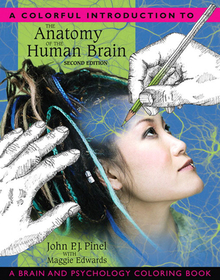
A Colorful Introduction to the Anatomy of the Human Brain
A Brain and Psychology Coloring Book
- Publisher's listprice USD 64.99
-
21 495 Ft (20 471 Ft + 5% VAT)
The price is estimated because at the time of ordering we do not know what conversion rates will apply to HUF / product currency when the book arrives. In case HUF is weaker, the price increases slightly, in case HUF is stronger, the price goes lower slightly.
- Discount 8% (cc. 1 720 Ft off)
- Discounted price 19 775 Ft (18 833 Ft + 5% VAT)
Subcribe now and take benefit of a favourable price.
Subscribe
21 495 Ft

Availability
Estimated delivery time: In stock at the publisher, but not at Prospero's office. Delivery time approx. 3-6 weeks.
Not in stock at Prospero.
Why don't you give exact delivery time?
Delivery time is estimated on our previous experiences. We give estimations only, because we order from outside Hungary, and the delivery time mainly depends on how quickly the publisher supplies the book. Faster or slower deliveries both happen, but we do our best to supply as quickly as possible.
Product details:
- Edition number 2, New edition
- Publisher Pearson
- Date of Publication 1 September 2007
- ISBN 9780205548743
- Binding Paperback
- No. of pages272 pages
- Size 274x217x13 mm
- Weight 617 g
- Language English 0
Categories
Short description:
Enter the fascinating world of the human brain and its amazing abilities with this colorful introduction to brain anatomy!
A Colorful Introduction to the Anatomy of the Human Brain: A Brain and Psychology Coloring Book was written by John Pinel and illustrated by Maggie Edwards, a team renowned for their ability to engage and fascinate the reader with their simple, cutting edge portrayals of the body's most complex organ and its psychological functions.
This hands-on workbook provides and easy and enjoyable means of learning and reviewing the fundamentals of human neuroanatomy through the acclaimed directed-coloring method. Because the text deals with only key concepts and progresses in small, logical, easy-to-learn increments, it is ideal for beginning students, professionals and lay people alike.
A Colorful Introduction to the Anatomy of the Human Brain: A Braining and Psychology Coloring Book includes these innovations:
- Many of the brain structures that are introduced in this book are examined from two perspectives: structural and functional. Part 1 introduces, defines and illustrates the location of the major brain structures, while Part 2 describes their psychological functions and positions in functioning circuits.
- The illustrations and text are designed to introduce key concepts and major structures clearly and simply without unnecessary detail, focusing only on key neuroanatomical concepts and structures.
- A fold-over cover flap attached to the back cover can be used to cover illustration labels on the pages in the book for review and self-testing.
- Each chapter ends with a series of review exercises that help you test your progress in four ways
- Each learning unit appears in a consistent two-page format to facilitate acquisition.
Long description:
This hands-on workbook provides and easy and enjoyable means of learning and reviewing the fundamentals of human neuroanatomy through the acclaimed directed-coloring method. Because the text deals with only key concepts and progresses in small, logical, easy-to-learn increments, it is ideal for the nonexpert-students, professionals and lay people alike.
There are other introductions to human brain anatomy, but this is a book with a difference. A Colorful Introduction to the Anatomy of the Human Brain: A Brain and Psychology Coloring Book was written by John Pinel and illustrated by Maggie Edwards, a team renowned for their ability to engage and fascinate the reader with their simple, cutting edge portrayals of the body's most complex organ and its psychological functions.
MoreTable of Contents:
Preface.
To The Reader.
How to Use This Book.
PART 1: BASIC NEUROANATOMY.
Chapter 1: Organization of the Human Nervous System.
Introduction
1.1 Divisions of the Nervous System.
1.2 Divisions of the Central Nervous System.
1.3 Divisions of the Peripheral Nervous System.
1.4 Organization of the Spinal Cord.
1.5 Divisions of the Autonomic Nervous System.
1.6 The Endocrine System.
Review Exercises
Chapter 2: Planes and Directions in the Human Nervous System.
Introduction
2.1 Planes in the Human Brain.
2.2 Directions in the Human Nervous System.
2.3 Sides of the Human Nervous System.
Review Exercises
Chapter 3: Cells of the Nervous System.
Introduction
3.1 The Neuron: Its Major Regions.
3.2 The Neuron: Structures of the Cell Body.
3.3 The Neuron: Structures of the Terminal Buttons.
3.4 Neural Conduction Through Dendrites and Cell Body.
3.5 Axonal Conduction and Synaptic Transmission.
3.6 Myelination and Saltatory Conduction.
3.7 The Neuron Cell Membrane and Receptors.
3.8 Glial Cells
Review Exercises
Chapter 4: Early Development of the Human Nervous System.
Introduction
4.1 Development of the Neural Tube.
4.2 Six Processes of Early Neural Development.
4.3 Early Development of the Brain's Three Major Divisions.
4.4 Early Development of the Brain's Five Divisions.
4.5 Axon Growth: Correctly Wiring the Nervous System.
4.6 Adult Neurogenesis
Review Exercises
Chapter 5: Gross Anatomy of the Human Brain.
Introduction
5.1 Cerebral Hemispheres and Brain Stem.
5.2 The Five Divisions of the Mature Brain.
5.3 The Meninges.
5.4 The Cerebral Ventricles.
5.5 Tracts and Nuclei.
5.6 The Cerebral Commissures.
5.7 The Cranial Nerves.
Review Exercises
Chapter 6: Major Structures of the Brain Stem.
Introduction
6.1 Major Structures of the Myelencephalon.
6.2 Major Structures of the Metencephalon.
6.3 Major Structures of the Mesencephalon.
6.4 Diencephalon: The Thalamus.
6.5 Diencephalon: The Hypothalamus.
6.6 The Hypothalamus and Pituitary.
Review Exercises
Chapter 7: Major Structures of the Cerebral Hemispheres.
Introduction
7.1 Major Fissures of the Cerebral Hemispheres.
7.2 Lobes of the Cerebral Hemispheres.
7.3 Major Gyri of the Cerebral Hemispheres.
7.4 The Cerebral Cortex.
7.5 Divisions of the Cerebral Cortex.
7.6 Primary Sensory and Motor Areas.
7.7 Subcortical Structures: The Limbic System.
7.8 Subcortical Structures: The Basal Ganglia.
Review Exercises
Part II: FUNCTIONAL NEUROANATOMY.
Chapter 8: Sensory Systems of the Central Nervous System.
Introduction
8.1 Visual System: From Eye to Cortex.
8.2 Cortical Visual Areas.
8.3 Auditory System: From Ear to Cortex.
8.4 Cortical Auditory Areas.
8.5 Somatosensory System: From Receptors to Cortex.
8.6 Cortical Somatosensory Areas.
8.7 The Descending Analgesia Circuit.
Review Exercises
Chapter 9: Sensorimotor Pathways of the Central Nervous System.
Introduction
9.1 Sensorimotor Cortical Pathways.
9.2 Primary Motor Cortex.
9.3 The Descending Dorsolateral Motor Pathways.
9.4 The Descending Ventromedial Motor Pathways.
9.5 The Cerebellum and Basal Ganglia.
9.6 Parkinson's Disease and the Nigrostriatal Pathway.
Review Exercises
Chapter 10: Brain Structures and Memory.
Introduction
10.1 Hippocampal Formation and Memory: The Case of H.M.
10.2 Rhinal Cortex and Memory.
10.3 Hippocampus and Spatial Memory.
10.4 Medial Diencephalon and Memory: Korsakoff's Amnesia.
10.5 Basal Forebrain and Memory: Alzheimer's Amnesia.
Review Exercises
Chapter 11: Motivational Systems of the Brain.
Introduction
11.1 Hypothalamus and Eating.
11.2 Subfornical Organ and Deprivation-Induced Thirst.
11.3 Mesotelencephalic Dopamine System and Pleasure.
11.4 Neural Mechanisms of Fear and Anxiety.
11.5 Reticular Formation and Sleep.
11.6 Suprachiasmatic Nucleus and Circadian Rhythms.
11.7 Brain Stem Sex Circuits.
Review Exercises
Chapter 12: Cortical Localization of Language and Thinking.
Introduction
12.1 The Wernicke-Geschwind Model of Language.
12.2 Cortical Areas Implicated in Reading
12.3 Cortical Language Circuits: Mapped by Brain Stimulation
12.4 Major Areas of Prefrontal Cortex and Their Functions
12.5 Medial Prefrontal Cortex and Social Cognition
Review Exercises
Answers to Review Exercises
Index
More

