

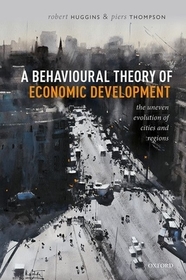
A Behavioural Theory of Economic Development
The Uneven Evolution of Cities and Regions
- Publisher's listprice GBP 102.50
-
46 278 Ft (44 075 Ft + 5% VAT)
The price is estimated because at the time of ordering we do not know what conversion rates will apply to HUF / product currency when the book arrives. In case HUF is weaker, the price increases slightly, in case HUF is stronger, the price goes lower slightly.
- Discount 10% (cc. 4 628 Ft off)
- Discounted price 41 651 Ft (39 668 Ft + 5% VAT)
Subcribe now and take benefit of a favourable price.
Subscribe
46 278 Ft

Availability
printed on demand
Why don't you give exact delivery time?
Delivery time is estimated on our previous experiences. We give estimations only, because we order from outside Hungary, and the delivery time mainly depends on how quickly the publisher supplies the book. Faster or slower deliveries both happen, but we do our best to supply as quickly as possible.
Product details:
- Publisher OUP Oxford
- Date of Publication 14 January 2021
- ISBN 9780198832348
- Binding Hardback
- No. of pages324 pages
- Size 21x164x242 mm
- Weight 700 g
- Language English 71
Categories
Short description:
This book establishes a novel behavioural theory of economic development to illustrate that differences in human behaviour across cities and regions, both individually and collectively, are a significant deep-rooted cause of uneven development within and across nations.
MoreLong description:
Innovation, entrepreneurship, knowledge, and human capital are widely acknowledged as key levers of development. Yet what are the sources of these factors, and why do they differ in their endowment across regions? Motivated by a belief that theories of economic development can move beyond the generally accepted explanations of location and the organization of industries and capital, this book establishes a behavioural theory of economic development illustrating that differences in human behaviour across cities and regions are a significant deep-rooted cause of uneven development.
Fusing a range of concepts relating to culture, psychology, human agency, institutions, and power, it proposes that the long-term differentials in economic development between cities and regions, both within and across nations, is strongly connected to the underlying forms of behaviour enacted by humans on an individual and collective basis. Given a world of finite and limited resources, coupled with a rapidly growing population -- especially in cities and urban regions -- human behaviour, and the expectations and preferences upon which it is based, are central to understanding how notions of development may change in coming years. This book provides a novel theory of the role of psychocultural context and human behavioural and institutional frameworks in uneven economic development on a global scale.
A Behavioural Theory of Economic Development can and should become a guide for researchers who want to give culture and agency the place they deserve in the study of urban and regional development. The volume extends our knowledge of individual and group behaviour with respect to regional development. And it stimulates one to look for the right methods, both quantitative and qualitative, to capture the cultural dimension of it in the best way
Table of Contents:
Introduction: Behaviour and the Development Problem
Human Behaviour and the Development of Cities and Regions
The Psychocultural Life of Cities and Regions
Agency, Economic Evolution, and History
Institutions, Capital, and Network Behaviour
The Co-Evolution of Culture, Psychology, and Institutions
The Nature and Sources of Agency
Agency, Entrepreneurship, and Innovation
An Extended Behavioural Model of Economic Development
Addressing Unevenness

