

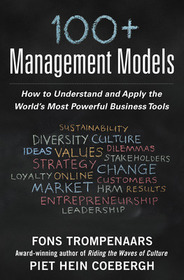
100+ Management Models: How to Understand and Apply the World's Most Powerful Business Tools
How to Understand and Apply the World's Most Powerful Business Tools
- Publisher's listprice GBP 54.99
-
24 827 Ft (23 645 Ft + 5% VAT)
The price is estimated because at the time of ordering we do not know what conversion rates will apply to HUF / product currency when the book arrives. In case HUF is weaker, the price increases slightly, in case HUF is stronger, the price goes lower slightly.
- Discount 10% (cc. 2 482 Ft off)
- Discounted price 22 345 Ft (21 281 Ft + 5% VAT)
Subcribe now and take benefit of a favourable price.
Subscribe
24 827 Ft

Availability
printed on demand
Why don't you give exact delivery time?
Delivery time is estimated on our previous experiences. We give estimations only, because we order from outside Hungary, and the delivery time mainly depends on how quickly the publisher supplies the book. Faster or slower deliveries both happen, but we do our best to supply as quickly as possible.
Product details:
- Publisher McGraw Hill
- Date of Publication 16 January 2015
- ISBN 9780071834605
- Binding Hardback
- No. of pages592 pages
- Size 233x162x48 mm
- Weight 848 g
- Language English 100
Categories
Long description:
The one-stop resource to 100+ powerful management methods
100+ Management Models offers a quick overview of the key features and potential applications of each of the most important models in nine different categories: sustainability, innovation, strategy, diversity, customers, human resources, benchmarking, leadership, and implementation. Each section concludes with a summary of the key dilemmas that tend to emerge from the particular function, along with analysis of potential solutions.
Fons Trompenaars is a world expert on international management and the author of the global bestseller Riding the Waves of Culture. He is a recipient of the International Professional Practice Area Research Award by the American Society for Training and Development (ASTD).
Piet Hein Coebergh is an expert in formulating and communicating corporate strategy. He is a lecturer at the University of Applied Sciences, Leiden, and managing consultant at Coebergh Communications & PR.
The one-stop resource to 100+ powerful management methods
100+ Management Models offers a quick overview of the key features and potential applications of each of the most important models in nine different categories: sustainability, innovation, strategy, diversity, customers, human resources, benchmarking, leadership, and implementation. Each section concludes with a summary of the key dilemmas that tend to emerge from the particular function, along with analysis of potential solutions.
Fons Trompenaars is a world expert on international management and the author of the global bestseller Riding the Waves of Culture. He is a recipient of the International Professional Practice Area Research Award by the American Society for Training and Development (ASTD).
Piet Hein Coebergh is an expert in formulating and communicating corporate strategy. He is a lecturer at the University of Applied Sciences, Leiden, and managing consultant at Coebergh Communications & PR.
Table of Contents:
Preface xi
Introduction 1
The Goals of this Book 1
Evolution of Management Theories and Models 3
Conceptual Models: Handle with Care 11
Applying Models in Practice 14
Dilemmas 14
PART 1 SUSTAINABILITY 25
Model 1 Stakeholder Management, Edward Freeman (1984) 29
Model 2 Seven Levels of Sustainability, Richard Barrett (1998) 31
Model 3 The Seven Faces of Mount Sustainability, Ray Anderson (1999) 33
Model 4 The Bottom of the Pyramid, C.K. Prahalad (2002) 36
Model 5 Cradle to Cradle, William McDonough and MichaelBraungart (2002) 38
Model 6 The Sustainable Value Framework, Stuart Hart andMark Milstein (2003) 40
Model 7 Multiple Stakeholder Sustainability, Fons Trompenaars and Peter Woolliams (2010) 43
Reflections on Sustainability 47
PART 2 INNOVATION AND ENTREPRENEURSHIP 73
Model 8 Flow, Mihaly Csikszentmihalyi (1975) 77
Model 9 Adaption-Innovation Inventory, Michael Kirton (1976) 79
Model 10 The Entrepreneurial Process, Jeffry Timmons (1989) 81
Model 11 Disruptive Innovation, Clayton Christensen (1995) 84
Model 12 Serious Play, Michael Schrage (1999) 86
Model 13 Open Innovation, Henry Chesbrough (2003) 88
Model 14 Reverse Innovation, Vijay Govindarajan (2009) 91
Reflections on Innovation and Entrepreneurship 93
PART 3 STRATEGY AND POSITIONING 123
Model 15 Product/Market Growth Matrix, Igor Ansoff (1957) 127
Model 16 3C: Company, Customer, Competition, Kenichi Ohmae (1975) 129
Model 17 Crafting Strategy, Henry Mintzberg (1978) 132
Model 18 Five Forces, Michael Porter (1979) 134
Model 19 7S: Tom Peters, Robert Waterman, Julien Phillips (1980) 136
Model 20 Core Competencies, Gary Hamel and C.K. Prahalad (1990) 138
Model 21 Brand Equity, David Aaker (1991) 141
Model 22 Value Discipline, Michael Treacy and Fred Wiersema (1993) 143
Model 23 Blue Ocean Strategy, W. Chan Kim and Renée Mauborgne (2005) 145
Reflections on Strategy and Positioning 149
PART 4 DIVERSITY OF CULTURES 177
Model 24 Myers-Briggs Type Indicator (MBTI), Isabel Briggs Myers and Katharine Cook Briggs (1962) 181
Model 25 Corporate Culture, Charles Handy and Roger Harrison (1976) 183
Model 26 Hofstede’s Cultural Dimensions, Geert Hofstede (1980) 186
Model 27 Belbin’s Team Roles, Meredith Belbin (1981) 188
Model 28 Competing Values Framework (CVF), Robert Quinn andKim Cameron (1981) 190
Model 29 Three Levels of Culture, Edgar Schein (1985) 193
Model 30 Developmental Model of Intercultural Sensitivity (DMIS), Milton Bennett (1986) 195
Model 31 Spiral Dynamics, Don Beck and Chris Cowan (1996) 198
Model 32 Seven Dimensions of Culture, Fons Trompenaars andCharles Hampden-Turner (1993) 201
Model 33 The Colour Theory of Change, Léon de Caluwé andHans Vermaak (2006) 204
Reflections on Diversity and Culture 207
PART 5 CUSTOMERS
Model 34 Rokeach Value Survey (RVS), Milton Rokeach (1973) 241
Model 35 Consumer Behaviour, John Howard and Jagdish Sheth (1969) 243
Model 36 3Rs—Retail, Reputation, Relationship, Corstiaan Marinus Storm (1987) 246
Model 37 Strategic Purchasing, Peter Kraljic (1983) 248
Model 38 Total Perceived Service Quality, Christian Grönroos (1984) 250
Model 39 Customer Satisfaction, Noriaki Kano (1984) 252
Model 40 Elaboration Likelihood Model (ELM), Richard Petty and John Cacioppo (1986) 254
Model 41 Service-Profit Chain, James Heskett, Thomas Jones,Gary Loveman, Earl Sasser and Leonard Schlesinger (1994) 257
Model 42 Customer Loyalty, Thomas Jones and Earl Sasser (1995) 259
Model 43 Six Stages of Social Business Transformation, Charlene Li and Brian Solis (2013) 261
Reflections on Customers 265
PART 6 HUMAN RESOURCE MANAGEMENT 291
Model 44 Gainsharing, Joseph Scanlon (1948) 294
Model 45 Two-Factor Theory, Frederick Herzberg (1959) 296
Model 46 Theory X and Theory Y, Douglas McGregor (1960) 299
Model 47 Evolutionary Growth of Organizations, Larry Greiner (1972) 301
Model 48 AMO: Abilities, Motivation, Opportunities, Thomas Bailey (1993) 303
Model 49 HRM Roles, David Ulrich (1997) 306
Model 50 The Happiness Factory, Maurits Bruel and Clemens Colson (1998) 309
Model 51 Contextually Based HR Theory, Jaap Paauwe (2004) 311
Model 52 Competence-Based Employability, Claudia van der Heijde and Beatrice van der Heijden (2006) 314
Reflections on Human Resource Management 317
PART 7 BENCHMARKING AND RESULTS 343
Model 53 Management by Objectives, Peter Drucker (1954) 346
Model 54 BCG Matrix, Bruce Henderson (1968) 348
Model 55 GE-McKinsey Matrix, General Electric and McKinseyConsulting (1971) 350
Model 56 The Value Chain, Michael Porter (1985) 352
Model 57 Identity and Image, Klaus Birkigt and Marinus Stadler (1986) 354
Model 58 Business Process Management (BPM), Michael Hammer (1990) 357
Model 59 Balanced Scorecard, Robert Kaplan and David Norton (1992) 359
Model 60 Social Media ROI Pyramid, Jeremiah Owyang (2010) 361
Reflections on Benchmarking and Results 365
PART 8 LEADERSHIP AND COMMUNICATION 395
Model 61 Managerial Grid, Robert Blake and Jane Mouton (1964) 398
Model 62 Situational Leadership, Paul Hersey and KennethBlanchard (1969) 401
Model 63 Servant Leadership, Robert Greenleaf (1970) 403
Model 64 8-Step Change, John Kotter 405
Model 65 Situational Crisis Communication Theory, TimothyCoombs (1995) 408
Model 66 Level 5 Leadership, Jim Collins (2001) 411
Model 67 Cynefin, David Snowden and Mary Boone (2007) 413
Model 68 Communication and Employee Engagement, Mary Welch (2011) 416
Reflections on Leadership and Communication 419
PART 9 MODELS FOR IMPLEMENTATION 455
Model 69 Ethos, Pathos, Logos, Aristotle (350 BC) 458
Model 70 AIDA, Elias St. Elmo Lewis (1898) 460
Model 71 DuPont Model, Frank Donaldson Brown (1914) 462
Model 72 Continuous Improvement, William Edwards Deming (1948) 464
Model 73 Brainstorming, Alex Osborn (1953) 466
Model 74 Leary’s Rose, Timothy Leary (1957) 468
Model 75 Bi-sociation, Arthur Koestler (1964) 470
Model 76 Small Group Development, Bruce Tuckman (1965) 472
Model 77 360-Degree Feedback, Edward Lawler (1967) 474
Model 78 Lateral Thinking, Edward de Bono (1967) 476
Model 79 The Conscious Competence Ladder, Lewis Robinson (1974) 478
Model 80 FCB Grid, Richard Vaughn (1980) 480
Model 81 SWOT, Heinz Weihrich (1982) 482
Model 82 Means-End Analysis, Jonathan Gutman (1982) 484Model 83 Learning Style Inventory, David A. Kolb (1984) 486
Model 84 Six Principles of Influence, Robert Cialdini (1984) 488
Model 85 Scrum, Hirotaka Takeuchi and Ikujiro Nonaka (1986) 490
Model 86 The Seven Habits of Highly Effective People, Stephen Covey (1989) 492
Model 87 Benchmarking, Robert Camp (1989) 494
Model 88 EFQM Excellence Model, The European Foundation for Quality Management (EFQM) (1991) 496
Model 89 Strategic Dialogue, Mathieu de Vaan, Steven ten Have and Wouter ten Have (1996) 498
Model 90 Strategic Personnel Planning, Gerard Evers and Cornelis Verhoeven (1999) 500
Model 91 Mapping, Bridging, Integrating (MBI), Joseph DiStefano and Martha Maznevski (2000) 502
Model 92 Yellow Box, Mark Raison (2002) 504
Model 93 Elements of Website User Experience, Jesse James Garrett (2002) 506
Model 94 MDA Design for “Gamification,” Robin Hunicke, Marc LeBlanc and Robert Zubek (2004) 508
Model 95 Business Model Canvas, Alexander Osterwalder (2008) 510
Model 96 Sustainability Roadmap, Ram Nidumolu, C.K. Prahalad and M.R. Rangaswami (2009) 512
Model 97 Balancing Transparency, Piet Hein Coebergh andEdi Cohen (2009) 514
Model 98 Blue Leadership, Jan Moen and Paul Ansems 516
Model 99 The Blue Economy, Gunter Pauli (2010) 518
Model 100 Eight Routes for Culture Change, Jaap Boonstra (2013) 520
Reflections on Models for Implementation 523
Conclusion 525
About the Authors 531
Our Thanks 532
Bibliography 533
Sources for the Visualizations of Models 559
Index 567

