

- Publisher's listprice GBP 29.99
-
13 540 Ft (12 895 Ft + 5% VAT)
The price is estimated because at the time of ordering we do not know what conversion rates will apply to HUF / product currency when the book arrives. In case HUF is weaker, the price increases slightly, in case HUF is stronger, the price goes lower slightly.
- Discount % (cc. 0 Ft off)
- Discounted price 0 Ft (0 Ft + 5% VAT)
Subcribe now and take benefit of a favourable price.
Subscribe
13 540 Ft

Availability
Estimated delivery time: In stock at the publisher, but not at Prospero's office. Delivery time approx. 3-5 weeks.
Not in stock at Prospero.
Why don't you give exact delivery time?
Delivery time is estimated on our previous experiences. We give estimations only, because we order from outside Hungary, and the delivery time mainly depends on how quickly the publisher supplies the book. Faster or slower deliveries both happen, but we do our best to supply as quickly as possible.
Product details:
- Publisher Cambridge University Press
- Date of Publication 14 May 2026
- ISBN 9781108928243
- Binding Paperback
- No. of pages247 pages
- Size 229x152x13 mm
- Weight 365 g
- Language English 0
Categories
Short description:
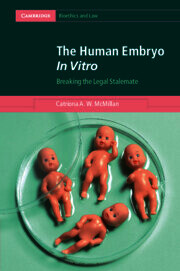
Proposes that the human embryo in vitro is in a unique 'legal stasis' between potential person and useful research artefact.
MoreLong description:
The Human Embryo in vitro explores the ways in which UK law engages with embryonic processes under the Human Fertilisation and Embryology Act 1990 (as amended), the intellectual basis of which has not been reconsidered for almost thirty years. McMillan argues that in regulating 'the embryo' - that is, a processual liminal entity in itself - the law is regulating for uncertainty. This book offers a fuller understanding of how complex biological processes of development and growth can be better aligned with a legal framework that purports to pay respect to the embryo while also allowing its destruction. To do so it employs an anthropological concept, liminality, which is itself concerned with revealing the dynamics of process. The implications of this for contemporary regulation of artificial reproduction are fully explored, and recommendations are offered for international regimes on how they can better align biological reality with social policy and law.
'Offering a strikingly fresh perspective on the regulation of human embryos, this valuable new book argues persuasively that the law's attempt to ascribe a single fixed status to 'the embryo' is destined to fail, and that we should acknowledge instead the fluid, context-specific and essentially liminal nature of human embryos in vitro.' Emily Jackson, Professor of Law, The London School of Economics and Political Science
Table of Contents:
Introduction; Part I. Into Liminality: 1. The evolution of 'the embryo' in law: a matter of process?; 2. 'The embryo' in law today: the human fertilisation and embryology act 1990 and beyond; 3. From process to purgatory: moving beyond legal stasis; Part II. Through Liminality: 4. Navigating legal purgatory: the otherness of embryos; 5. A liminal lens; Part III. Out of liminality: 6. A context based approach; 7. Looking forward: the 14-day rule, in vitro gametogenesis, and ectogenesis; Conclusion; Bibliography.
More
