

-
GET 10% OFF
- Publisher's listprice GBP 54.99
-
24 827 Ft (23 645 Ft + 5% VAT)
The price is estimated because at the time of ordering we do not know what conversion rates will apply to HUF / product currency when the book arrives. In case HUF is weaker, the price increases slightly, in case HUF is stronger, the price goes lower slightly.
- Discount 10% (cc. 2 483 Ft off)
- Discounted price 22 345 Ft (21 281 Ft + 5% VAT)
22 345 Ft

Availability
Not yet published.
Why don't you give exact delivery time?
Delivery time is estimated on our previous experiences. We give estimations only, because we order from outside Hungary, and the delivery time mainly depends on how quickly the publisher supplies the book. Faster or slower deliveries both happen, but we do our best to supply as quickly as possible.
Product details:
- Edition number 1
- Publisher CRC Press
- Date of Publication 15 September 2026
- ISBN 9781041407003
- Binding Hardback
- No. of pages152 pages
- Size 216x138 mm
- Language English
- Illustrations 3 Illustrations, black & white; 3 Line drawings, black & white; 3 Tables, black & white 0
Categories
Short description:
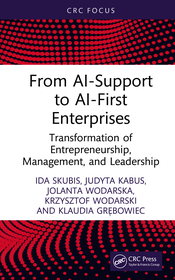
Artificial intelligence is changing the way organizations make decisions, manage projects, and approach leadership. Combining perspectives from management, innovation, and AI ethics, this book explores integrated AI systems, intelligent automation, and the appearance of humanoid and virtual leaders.
MoreLong description:
Artificial intelligence is becoming an increasingly visible element of business management, influencing not only operational processes but also strategic planning, financial management, leadership, and organizational governance. This book examines these changes from an interdisciplinary perspective, combining management studies, innovation research, AI ethics, and enterprise decision-making. Rather than presenting artificial intelligence solely as a technological tool, the volume explores its growing role in shaping organizational structures, managerial practices, and new models of leadership.
The chapters discuss integrated AI systems, intelligent process automation, predictive analytics, and AI-supported decision-making across strategic, operational, and financial dimensions. Particular attention is devoted to the appearance of humanoid and virtual leaders, including the cases of Mika, the humanoid CEO, and Tang Yu, the virtual CEO. These examples are used to analyze how AI is increasingly embedded within executive and managerial functions, raising important questions about accountability, transparency, human oversight, explainability, and the future role of managers in organizations.
The volume additionally includes an empirical market analysis conducted among 192 enterprises representing sectors such as manufacturing, logistics, finance, trade, technology, and services. The findings illustrate how organizations implement AI technologies, what barriers they encounter, and how intelligent systems influence organizational efficiency, strategic adaptability, customer relations, and innovation processes.
At the same time, the book addresses broader organizational and societal implications connected with AI adoption, including workforce transformation, algorithmic bias, governance challenges, and changing forms of human–machine collaboration. Combining theoretical discussion with case studies and practical examples, the volume offers a critical and accessible examination of how artificial intelligence is influencing entrepreneurship, enterprise management, and leadership in the digital economy.
MoreTable of Contents:
Introduction. Chapter 1 Artificial intelligence as a factor of transformation, innovation or a new paradigm of development in entrepreneurship. Chapter 2 Integrated AI Systems Supporting Strategic, Operational and Financial Management: An Overview of Approaches and Case Studie. Chapter 3 Humanoid and Virtual Leaders as a New Model of Decision-Making in Enterprises: Case Studies of Mika and Tang Yu. Chapter 4 Market analysis: Empirical Perspectives on AI-Driven Enterprise Transformation. Conclusions
More

