

-
GET 10% OFF
- Publisher's listprice GBP 29.99
-
13 540 Ft (12 895 Ft + 5% VAT)
The price is estimated because at the time of ordering we do not know what conversion rates will apply to HUF / product currency when the book arrives. In case HUF is weaker, the price increases slightly, in case HUF is stronger, the price goes lower slightly.
- Discount 10% (cc. 1 354 Ft off)
- Discounted price 12 186 Ft (11 606 Ft + 5% VAT)
12 186 Ft

Availability
Not yet published.
Why don't you give exact delivery time?
Delivery time is estimated on our previous experiences. We give estimations only, because we order from outside Hungary, and the delivery time mainly depends on how quickly the publisher supplies the book. Faster or slower deliveries both happen, but we do our best to supply as quickly as possible.
Product details:
- Edition number 1
- Publisher Routledge
- Date of Publication 10 August 2026
- ISBN 9781041022237
- Binding Paperback
- No. of pages238 pages
- Size 246x174 mm
- Language English 700
Categories
Short description:
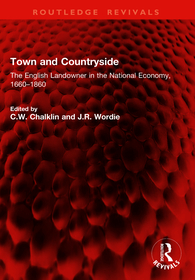
During the eighteenth century, England’s landowners played a vital role in the growth of the national economy. First published in 1989, Town and Countryside draws together important research on the ways in which both urban and rural landed classes promoted this growth in industry, commerce, and agriculture.
MoreLong description:
During the eighteenth century, England’s landowners played a vital role in the growth of the national economy. First published in 1989, Town and Countryside draws together important research on the ways in which both urban and rural landed classes promoted this growth in industry, commerce, and agriculture. It offers the student and specialist new perspectives on the economic and social history of early modern England.
The book discusses the acquisition and management of landed estates, the importance of corporate landowners in urban development and the role of landowners in industry and commerce. Examples are taken from major cities such as Bristol, Birmingham, Reading, and Liverpool and from a range of country landowners from Devon to Berkshire and Shropshire. A substantial introduction draws these case studies together to link the social and political framework, the prevailing economic philosophy, fiscal policy, and the nation’s rate of economic growth.
Illustrated with maps and contemporary drawings, this is a distinctive contribution to English economic and social history which will be welcomed by teachers and students alike.
Reviews of the first publication:
‘… this is an admirable and most welcome volume… it undoubtedly adds to the density and richness of our knowledge of the role of the landowner in the English economy between 1660 and 1860.’
— Angus Mcinnes, Agricultural History Review, Volume 42
‘… this is an interesting and stimulating collection of studies by able scholar,’
— Philip Jenkins, Albion: A Quarterly Journal Concerned with British Studies, Vol. 23, No. 1
MoreTable of Contents:
1. Introduction 2. A country gentleman and his estates, c. 1720–68: Sir Mark Stuart Pleydell, Bart., of Coleshill, Berkshire 3. The purchase and management of Guy’s Hospital estates, 1726–1806 4. A progressive landlord: the third Earl Spencer, 1782–1845 5. Estate development in Bristol, Birmingham and Liverpool, 1660–1720 6. Liverpool Corporations as landowners and dock builders, 1709–1835 7. The development of the Crown and Corporation Estates at Reading, 1828–60 8. A Devon family and their estates: the Northcotes of Upton Pyne, 1660–1851 9. Aristocrats and entrepreneurs in the Shropshire mining industry, 1748–1803
More
