

-
GET 10% OFF
- Publisher's listprice GBP 160.00
-
72 240 Ft (68 800 Ft + 5% VAT)
The price is estimated because at the time of ordering we do not know what conversion rates will apply to HUF / product currency when the book arrives. In case HUF is weaker, the price increases slightly, in case HUF is stronger, the price goes lower slightly.
- Discount 10% (cc. 7 224 Ft off)
- Discounted price 65 016 Ft (61 920 Ft + 5% VAT)
65 016 Ft

Availability
Not yet published.
Why don't you give exact delivery time?
Delivery time is estimated on our previous experiences. We give estimations only, because we order from outside Hungary, and the delivery time mainly depends on how quickly the publisher supplies the book. Faster or slower deliveries both happen, but we do our best to supply as quickly as possible.
Product details:
- Edition number 1
- Publisher Routledge
- Date of Publication 18 September 2026
- ISBN 9781032880440
- Binding Hardback
- No. of pages404 pages
- Size 234x156 mm
- Language English
- Illustrations 4 Illustrations, black & white; 4 Halftones, black & white 0
Categories
Short description:
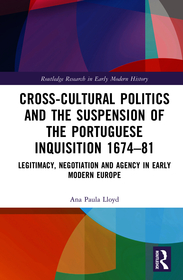
This book tells the story of the unprecedented suspension of the Portuguese Inquisition (1674-81), a negotiation that started with a request for a general pardon but quickly developed into a crisis over the legitimacy of the Inquisition itself.
MoreLong description:
This book tells the story of the unprecedented suspension of the Portuguese Inquisition (1674-81), a negotiation that started with a request for a general pardon but quickly developed into a crisis over the legitimacy of the Inquisition itself. This analysis of the denouement in the long struggle between New Christians, as forced converts from Judaism were known in Iberia and their persecutors, the Portuguese Inquisition, moves away from binary and national, religious or economic perspectives, arguing that the suspension was entirely political.
Taking a transnational approach, this book focuses on agency and decision-making, exploring not only the crucial Roman dimension, but examining all the actors involved; from New Christian merchants, Jesuit fathers, Inquisitors and bishops to the cardinals of the Roman Inquisition asking just how it was possible to bring such an apparently powerful institution to the brink and its efforts to defend itself. The book is an in-depth study of negotiators and negotiations. Using the analytical idea of cross-cultural politics, the book shows how liminal groups could use the skills and connections gained through cross-cultural trade, translating economic trust into political leverage, to galvanic effect. The New Christians acted as diplomats for themselves, questioning the Inquisition’s legitimacy and methods, pioneering appeals for minority rights in the face of institutional repression.
This book will be of interest to political and social historians of early modern Europe, Iberian and Italian studies, the Inquisition, Catholicism, and legal histories of rights. It also speaks to scholars of diaspora, transnational history, and minority agency.
MoreTable of Contents:
List of Illustrations
List of Abbreviations
Acknowledgements
INTRODUCTION
PART ONE : NETWORKS
CHAPTER ONE: The Portuguese Inquisition: From Opportunity to Crisis 1668–1673
CHAPTER TWO: Portuguese New Christians: Cross-Cultural Politics, Representation and Trade
CHAPTER THREE: The Jesuits: Problems and Problem-Solvers
CHAPTER FOUR: Portuguese New Christians in Rome: Informal Diplomacy and Cross- Cultural Political Communication
PART TWO: COMMUNICATION
CHAPTER FIVE: Secrecy, Subversion and Surveillance: The Practice of Opposing the Inquisition
CHAPTER SIX: The General Council of the Inquisition and the Bishops: Survival Strategies
CHAPTER SEVEN: The Jesuits: Re-Inventing the Inquisition
PART THREE: DECISION MAKERS
CHAPTER EIGHT: The Cardinals of the Roman Inquisition: Information Masters
CONCLUSION
Bibliography
Index
More
