

-
GET 10% OFF
- Publisher's listprice GBP 155.00
-
69 982 Ft (66 650 Ft + 5% VAT)
The price is estimated because at the time of ordering we do not know what conversion rates will apply to HUF / product currency when the book arrives. In case HUF is weaker, the price increases slightly, in case HUF is stronger, the price goes lower slightly.
- Discount 10% (cc. 6 998 Ft off)
- Discounted price 62 984 Ft (59 985 Ft + 5% VAT)
62 984 Ft

Availability
Not yet published.
Why don't you give exact delivery time?
Delivery time is estimated on our previous experiences. We give estimations only, because we order from outside Hungary, and the delivery time mainly depends on how quickly the publisher supplies the book. Faster or slower deliveries both happen, but we do our best to supply as quickly as possible.
Product details:
- Edition number 1
- Publisher Routledge
- Date of Publication 26 August 2026
- ISBN 9781032546360
- Binding Hardback
- No. of pages346 pages
- Size 234x156 mm
- Weight 453 g
- Language English
- Illustrations 18 Illustrations, black & white; 18 Line drawings, black & white; 12 Tables, black & white 0
Categories
Short description:
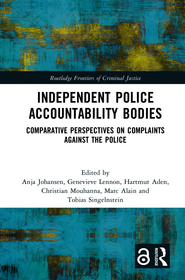
This book provides a comparative analysis of independent police complaints bodies in Canada, France, Germany, Japan and the UK. It explores the political, cultural and institutional contexts shaping police accountability arrangements and transnational dynamics, assessing the prospects for future convergence around international standards.
MoreLong description:
This book provides a detailed comparative analysis of independent police complaints bodies (IPCBs) in Canada, France, Germany, Japan and the UK. It explores the distinctive political, cultural and institutional contexts shaping police accountability arrangements within each country, as well as the transnational dynamics behind the remarkable proliferation of IPCBs over the past three decades, assessing the prospects for future convergence around international standards.
Drawing on findings from the international project ‘Police Accountability: Towards International Standards?’, the book examines the inherent dilemmas and challenges in the everyday functioning and dynamics of IPCB reform. Each chapter presents integrated comparative analysis of key themes co-written by experts on police accountability in Canada, France, Germany, Japan, and the UK. The scholars involved approach the topic from range of scholarly disciplines: police studies and public administration, law, sociology, human geography, and history. Its qualitative comparative analysis adds to the existing literature on IPCBs based on single-country research.
The book facilitates exchange of knowledge and experiences across political cultures and linguistic boundaries, revising theoretical perspectives and through its empirical findings providing scholars, complaints practitioners and rights activists with unique frameworks to contextualise and assess current and emerging IPCB models in any country or jurisdiction.
This book will be useful reading for all those engaged in policing, public administration, rights activism, and law and policymaking.
The Open Access version of this book, available at www.taylorfrancis.com, has been made available under a Creative Commons [Attribution-Non Commercial-No Derivatives (CC BY-NC-ND)] 4.0 International license.
This volume offers a major contribution to the comparative study of police accountability through its integrated qualitative analysis of Independent Police Complaints Bodies across multiple jurisdictions within five democratic countries. It identifies shared structural dilemmas—concerning independence, authority, resources, and legitimacy—that transcend national and institutional differences. By grounding its empirical findings in international human rights standards, the book advances both conceptual precision and normative debate, making it essential reading for scholars and policymakers engaged in the governance of police oversight.
Professor Daniela Hunold, Department of Police and Security Management, Berlin School of Economics and Law.
Holding police to account is both more challenging and more pressing than ever before and this collection provides invaluable insight and analysis of international efforts to this end. Using original evidence, the authors analyse not only the formal arrangements of accountability but also the power dynamics and cultural and normative frameworks in which they operate. This is an important evidence base that can help to secure democratic oversight of policing.
Professor Michael Rowe, Northumbria University, UK
The proliferation of "independent" mechanisms for handling citizen complaints against the police is remarkable. Why and how did this innovation emerge? This essential work provides answers based on research from five countries. It highlights the commonalities underlying the diversity of implementations and how the actors involved have responded. An indispensable resource for policing scholars.
Professor Sebastian Roché, CNRS Research Pr., Sciences-Po/University of Grenoble Alpes.
More
Table of Contents:
1. Introduction: Independent Police Complaints Handling in International Comparative Contexts 2. Mapping the Landscapes of Independent Police Complaints Bodies: Institutional Frameworks and Resourcing 3. Theories and Normative Concepts for Understanding and Comparing Independent Police Complaints Bodies 4. Institutional Context and Independence of Police Accountability Bodies: Between Theory and Practice 5. Objectives of Independent Police Complaints Bodies. 6. Complaining Against the Police: Historical Perspectives across the 19th and 20th Centuries 7. Dynamics of Reform: Independent Police Complaints Bodies Since the Turn of the Millennium 8. Police Accountability Bodies: Institutional Competition or Cooperation? 9. Investigative Powers of Independent Police Complaints Bodies and their Relationship with Criminal Proceedings 10. Complainants in the Eyes of the Complaints Practitioners 11. Public Opinion and Independent Police Complaints Bodies: The Knowledge Conundrum. 12. New Technologies and Complaints against the Police 13. The Dilemmas of Independent Police Complaints Bodies in Democracies

