

- Publisher's listprice GBP 18.00
-
8 127 Ft (7 740 Ft + 5% VAT)
The price is estimated because at the time of ordering we do not know what conversion rates will apply to HUF / product currency when the book arrives. In case HUF is weaker, the price increases slightly, in case HUF is stronger, the price goes lower slightly.
- Discount % (cc. 0 Ft off)
- Discounted price 0 Ft (0 Ft + 5% VAT)
Subcribe now and take benefit of a favourable price.
Subscribe
8 127 Ft

Availability
Estimated delivery time: In stock at the publisher, but not at Prospero's office. Delivery time approx. 3-5 weeks.
Not in stock at Prospero.
Why don't you give exact delivery time?
Delivery time is estimated on our previous experiences. We give estimations only, because we order from outside Hungary, and the delivery time mainly depends on how quickly the publisher supplies the book. Faster or slower deliveries both happen, but we do our best to supply as quickly as possible.
Product details:
- Publisher Cambridge University Press
- Date of Publication 30 April 2026
- ISBN 9781009613453
- Binding Paperback
- No. of pages96 pages
- Size 229x152x5 mm
- Weight 153 g
- Language English 700
Categories
Short description:
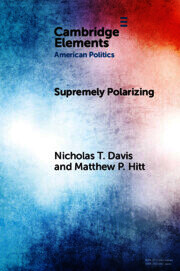
Supremely Polarizing investigates a partisan sorting out of public support for the Supreme Court.
MoreLong description:
Although the Supreme Court has historically resisted a partisan sorting out of its public legitimacy, today, Republicans and Democrats look at the Court in very different ways. This Element assembles original survey and experimental data to unpack these changes in three ways. First, the authors illustrate the powerful role that partisanship plays in shaping judicial public opinion. Second, they validate a new three-item measure of specific support and show that it reliably predicts perceptions of Supreme Court legitimacy. Finally, they introduce a new, applied measure of support for the rule of law and connect it to specific and diffuse support. Taken as a whole, their work demonstrates that large chunks of the mass public view the Supreme Court critically. Looking ahead, it is unclear whether legitimacy will rebound when citizens perceive that the balance of judicial power within the nation's High Court has fractured along party lines.
MoreTable of Contents:
Introduction; 1. A systems theory for changing times; 2. The sorting out of supreme court legitimacy; 3. Linking specific support to legitimacy; 4. Support for the rule of law and the supreme court; Conclusion: a fragile status Quo; Appendix; References.
More
