

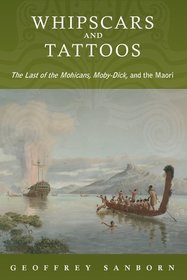
Whipscars and Tattoos
The Last of the Mohicans, Moby-Dick, and the Maori
- Publisher's listprice GBP 82.00
-
37 023 Ft (35 260 Ft + 5% VAT)
The price is estimated because at the time of ordering we do not know what conversion rates will apply to HUF / product currency when the book arrives. In case HUF is weaker, the price increases slightly, in case HUF is stronger, the price goes lower slightly.
- Discount 10% (cc. 3 702 Ft off)
- Discounted price 33 321 Ft (31 734 Ft + 5% VAT)
Subcribe now and take benefit of a favourable price.
Subscribe
37 023 Ft

Availability
printed on demand
Why don't you give exact delivery time?
Delivery time is estimated on our previous experiences. We give estimations only, because we order from outside Hungary, and the delivery time mainly depends on how quickly the publisher supplies the book. Faster or slower deliveries both happen, but we do our best to supply as quickly as possible.
Product details:
- Publisher OUP USA
- Date of Publication 24 February 2011
- ISBN 9780199751693
- Binding Hardback
- No. of pages204 pages
- Size 211x142x22 mm
- Weight 340 g
- Language English
- Illustrations 10 illustrations 0
Categories
Short description:
Through careful historical research, Geoffrey Sanborn reveals how both James Fenimore Cooper and Herman Melville relied heavily on contemporary accounts of the indigenous natives of New Zealand, the Maori, to develop the iconic characters they created in The Last of the Mohicans and Moby-Dick.
MoreLong description:
In this original study, Geoffrey Sanborn presents a fresh interpretation of the villanous Magua in James Fenimore Cooper's The Last of the Mohicans (1826) and of the dignified harpooner Queequeg in Herman Melville's Moby-Dick (1851). Through careful historical research, Sanborn has determined that both authors relied heavily on contemporary accounts of the indigenous natives of New Zealand, the Maori, to develop their iconic characters. Cooper drew heavily on the account of Te Aara in John Liddiard Nicholas's Narrative of a Voyage to New Zealand (1817) while Melville studied the personal history of Te Pehi Kupe in George Lillie Craik's The New Zealanders (1830) to flesh out his characterization of Queequeg. A close reading of the historical evidence and the source material supports this compelling line of argumentation. At the same time, this isn't a simple source study nor an act of explanatory historical recovery. The conception of the Maori is sophisticated and paradoxical, a portrait of violent but nonetheless idealized masculinity in which dignity depends on the existence of fiercely defiant pride. This lens allows Sanborn to present a radically different view of these fictional characters as well as underscoring the imaginative projection that went into reporting on the Maori themselves. Magua is no longer a stereotypical "bad Indian" or "ignoble savage," but rather a non-white "gentleman," an argument that supports Sanborn's contention that throughout his career Cooper prioritizes status equivalence over racial difference. Queequeg is similarly re-imagined, a move that allows Sanborn to explicate scenes in Moby-Dick that are often dodged by other critics because they do not fit with the standard interpretations of the character. The study as a whole provides a vivid example of the fascinating interplay between fiction and non-fiction in the nineteenth century.
This lucid book is critically and historically illuminating, and immensely pleasurable. Sanborn brings his careful historical, biographical, ethnographical study of the nineteenth-century Maori, who by the 1830s were being described as 'the most impressive people that Europeans had ever encountered' to his dense familiarity with the works of James Fenimore Cooper and Herman Melville. . . . Sketching Sanborn's intriguing claims does not begin to capture the charm of his project, which is so readable, even captivating, such a startling and rewarding engagement with both men and literature.
Table of Contents:
Acknowledgements
Abbreviations
Glossary
Introduction: Grand, Ungodly, Godlike Men
Index

