

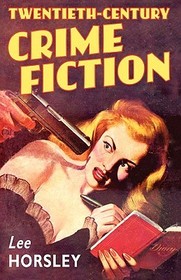
Twentieth-Century Crime Fiction
- Publisher's listprice GBP 45.99
-
20 764 Ft (19 775 Ft + 5% VAT)
The price is estimated because at the time of ordering we do not know what conversion rates will apply to HUF / product currency when the book arrives. In case HUF is weaker, the price increases slightly, in case HUF is stronger, the price goes lower slightly.
- Discount 10% (cc. 2 077 Ft off)
- Discounted price 18 687 Ft (17 798 Ft + 5% VAT)
Subcribe now and take benefit of a favourable price.
Subscribe
20 764 Ft

Availability
printed on demand
Why don't you give exact delivery time?
Delivery time is estimated on our previous experiences. We give estimations only, because we order from outside Hungary, and the delivery time mainly depends on how quickly the publisher supplies the book. Faster or slower deliveries both happen, but we do our best to supply as quickly as possible.
Product details:
- Publisher OUP Oxford
- Date of Publication 1 September 2005
- ISBN 9780199253265
- Binding Paperback
- No. of pages328 pages
- Size 217x139x18 mm
- Weight 438 g
- Language English 0
Categories
Short description:
This study examines a wide variety of twentieth-century Anglo-American detective and crime fiction. It will interest anyone who enjoys crime fiction, but is also designed to meet the needs of students, introducing important critical concepts and tracing generic development. Chapters 1-3 cover the main sub-genres of crime fiction from the days of Sherlock Holmes to those of Hannibal Lecter; chapters 4-6 discuss crime fiction as a vehicle for socio-political protest (e.g., in black and feminist crime novels).
MoreLong description:
Twentieth-Century Crime Fiction aims to enhance understanding of one of the most popular forms of genre fiction by examining a wide variety of the detective and crime fiction produced in Britain and America during the twentieth century. It will be of interest to anyone who enjoys reading crime fiction but is specifically designed with the needs of students in mind. It introduces different theoretical approaches to crime fiction (e.g., formalist, historicist, psychoanalytic, postcolonial, feminist) and will be a useful supplement to a range of crime fiction courses, whether they focus on historical contexts, ideological shifts, the emergence of sub-genres, or the application of critical theories. Forty-seven widely available stories and novels are chosen for detailed discussion.
In seeking to illuminate the relationship between different phases of generic development Lee Horsley employs an overlapping historical framework, with sections doubling back chronologically in order to explore the extent to which successive transformations have their roots within the earlier phases of crime writing, as well as responding in complex ways to the preoccupations and anxieties of their own eras. The first part of the study considers the nature and evolution of the main sub-genres of crime fiction: the classic and hard-boiled strands of detective fiction, the non-investigative crime novel (centred on transgressors or victims), and the 'mixed' form of the police procedural.
The second half of the study examines the ways in which writers have used crime fiction as a vehicle for socio-political critique. These chapters consider the evolution of committed, oppositional strategies, tracing the development of politicized detective and crime fiction, from Depression-era protests against economic injustice to more recent decades which have seen writers launching protests against ecological crimes, rampant consumerism, Reaganomics, racism, and sexism.
Table of Contents:
1. Classic Detective Fiction
The turn of the century: Sherlock Holmes and his contemporaries
Classic detection in the interwar years
Transforming the tradition in the 1950s and 1960s
2. Hard-Boiled Detective Fiction
The Black Mask boys
The mid-century paperback revolution
Contemporary investigations
3. Transgression and Pathology
The Prohibition-era gangsters
The killers inside us
Serial killers, pathologists, and police procedurals
4. Crime Fiction as Socio-Political Critique
Despairing of the Depression
Despoiling Florida
The politics of self-enrichment
5. Black Appropriations
'A Harlem of my mind'
Writing the other Los Angeles
Diasporic identities in contemporary Britain
Detectives, mammies, bitches, and whores
6. Regendering the Genre
Mothering feminist crime fiction in the 1970s
Butch vs. femme in the Reganite '80s
Unsolved crimes of the '90s
Into the twenty-first century

