

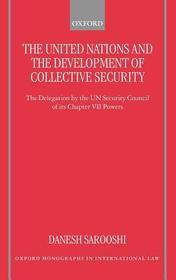
The United Nations and the Development of Collective Security
The Delegation by the UN Security Council of its Chapter VII Powers
Series: Oxford Monographs in International Law;
- Publisher's listprice GBP 250.00
-
119 437 Ft (113 750 Ft + 5% VAT)
The price is estimated because at the time of ordering we do not know what conversion rates will apply to HUF / product currency when the book arrives. In case HUF is weaker, the price increases slightly, in case HUF is stronger, the price goes lower slightly.
- Discount 10% (cc. 11 944 Ft off)
- Discounted price 107 494 Ft (102 375 Ft + 5% VAT)
Subcribe now and take benefit of a favourable price.
Subscribe
119 437 Ft

Availability
printed on demand
Why don't you give exact delivery time?
Delivery time is estimated on our previous experiences. We give estimations only, because we order from outside Hungary, and the delivery time mainly depends on how quickly the publisher supplies the book. Faster or slower deliveries both happen, but we do our best to supply as quickly as possible.
Product details:
- Publisher Clarendon Press
- Date of Publication 18 March 1999
- ISBN 9780198268635
- Binding Hardback
- No. of pages334 pages
- Size 243x163x23 mm
- Weight 633 g
- Language English 0
Categories
Short description:
This book provides a legal analysis of the institutional mechanisms and processes which the UN employs to use force to maintain or restore peace.
MoreLong description:
This book examines one of the most important challenges facing the United Nations today: the effective and lawful use of force by or under the authority of the UN to maintain or restore peace. In particular, the book provides a legal analysis of the institutional mechanisms and processes which the UN employs to use force to maintain or restore peace.
The UN Security Council is the main organ of the UN entrusted with the responsibility for the maintenance or restoration of peace. It is given broad powers of enforcement under Chapter VII of the UN Charter in order to achieve this objective. However, the Charter provision which was intended to provide the Council with a standing military force to carry out enforcement action has not as yet been implemented. In response, the Council has sought to deal with an increasing demand for military enforcement action by delegating its powers in this area to other UN organs (e.g. the UN Secretary-General in Somalia, and the War Crimes Tribunals for Rwanda and the former Yugoslavia), UN Member States (e.g. the coalition against Iraq), and regional and collective self-defence organizations (e.g. NATO in Bosnia). It is this process of delegation of military enforcement powers by the Council which is the focus of the book. By examining the legal framework which governs the process of a delegation by the Council of its Chapter VII powers; the practice relating to the exercise of these powers by each of the delegates concerned; and the policy issues relating to such delegations, the book makes a significant contribution to the content of the law pertaining to the use of force by the UN and provides guidance as to the likely future developments in the legal framework governing collective action to maintain peace under the auspices of the United Nations.
contains a thorough and meticulous analysis of the legal implications of the doctrine of delegation when applied in the field of collective security ... this book is a valuable contribution to the literature on the UN collective security system
Table of Contents:
Introduction
The General Legal Framework Governing the Process of a Delegation by the UN Security Council of its Chapter VII Powers
I. The Nature of the Process of a Delegation of Chapter VII Powers
II. The General Competence of the Security Council to Delegate its Chapter VII Powers
III. Limitations on the General Competence of the Security Council to Delegate its Chapter VII Powers
IV. The ICJ and the Justiciability of a Delegation of Chapter VII Powers
The Delegation of Powers to the UN Secretary-General
I. The Competence of the Council to Delegate Chapter VII Powers to the Secretary-General
II. The Legal Framework Governing the Exercise of Delegated Chapter VII Powers by the Secretary-General
III. The Practice of the Secretary-General in Exercising Delegated Chapter VII Powers
The Delegation of Powers to UN Subsidiary Organs
I. UN Subsidiary Organs: Issues of Definition
II. The Authority of UN Principal Organs to Establish Subsidiary Organs: the Competence of the Council to Delegate Chapter VII Powers to Subsidiary Organs
III. Preconditions for the Lawful Establishment of UN Subsidiary Organs
The Legal Framework Governing the Delegation of Powers to UN Member States
I. The Competence of the Council to Delegate Chapter VII Powers to UN member States
II. Limitations on the Competence of the Council to Delegate Chapter VII Powers to Member States
III. Responsibility for the Acts of A Force Carrying Out UN Authorised Military Enforcement Action
The Delegation of Powers to UN Member States
I. A Delegation of Powers to Counter a Use of Force by a State or Entities Within a State
II. A Delegation of Powers to Carry Out a Naval Interdiction
III. A Delegation of Powers to Achieve Humanitarian Objectives
IV. A Delegation of Powers to Enforce a Council Declared No-Fly Zone: The Case of Iraq
V. A Delegation of Powers to Ensure Implementation by Parties of an Agreement which The Council Has Deemed is Necessary for the Maintainance or Restoration of Peace
The Delegation of Powers to Regional Arrangements
I. The Competence of the Council to Delegate Chapter VII Powers to Regional Arrangements
II. The Delegation of Powers to NATO
III. The Policy of Delegating Chapter VII Powers to Regional Arrangements
Concluding Remarks
Bibliography
Index

