

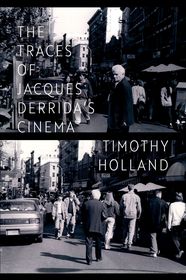
The Traces of Jacques Derrida's Cinema
- Publisher's listprice GBP 71.00
-
33 920 Ft (32 305 Ft + 5% VAT)
The price is estimated because at the time of ordering we do not know what conversion rates will apply to HUF / product currency when the book arrives. In case HUF is weaker, the price increases slightly, in case HUF is stronger, the price goes lower slightly.
- Discount 10% (cc. 3 392 Ft off)
- Discounted price 30 528 Ft (29 075 Ft + 5% VAT)
Subcribe now and take benefit of a favourable price.
Subscribe
33 920 Ft

Availability
printed on demand
Why don't you give exact delivery time?
Delivery time is estimated on our previous experiences. We give estimations only, because we order from outside Hungary, and the delivery time mainly depends on how quickly the publisher supplies the book. Faster or slower deliveries both happen, but we do our best to supply as quickly as possible.
Product details:
- Publisher OUP USA
- Date of Publication 23 April 2024
- ISBN 9780197694374
- Binding Hardback
- No. of pages280 pages
- Size 235x156 mm
- Weight 1160 g
- Language English
- Illustrations 23 b&w halftones 539
Categories
Short description:
Situated at the intersection of film and media studies, literary theory, and continental philosophy, The Traces of Jacques Derrida's Cinema provides a trenchant account of the role of cinema in the oeuvre of one of the most influential philosophers of the twentieth century, Jacques Derrida (1930-2004).
MoreLong description:
Situated at the intersection of film and media studies, literary theory, and continental philosophy, The Traces of Jacques Derrida's Cinema provides a trenchant account of the role of cinema in the oeuvre of one of the most influential philosophers of the twentieth century, Jacques Derrida (1930-2004). The book is animated by Derrida's self-confessed passion for the movies, his reluctance to write about film despite the range of his corpus, and the generative encounters arising between his legacy and the field of film and media studies as a result. Given the expanse of its references, interdisciplinarity, and consideration of Derrida's approach to the experience of both spectatorship and the act of being filmed, The Traces of Jacques Derrida's Cinema contributes to the ongoing close analyses of the philosopher's work while also providing a rigorous introduction to deconstruction.
Author Timothy Holland interweaves historical and speculative modes of research and writing to articulate the peripheral-yet surprisingly crucial-place of the cinematic medium for Derrida and his philosophical enterprise. The outcome is a meticulously detailed survey of the centers and margins of Derrida's oeuvre that include forays into such terrain as: his notable appearances in films; an unrealized project on cinema and belief that Derrida proposed in a 2001 interview; the correspondences between the strategies of deconstruction and the traditions, homecomings, and wordplay of David Lynch's cinematic media; and the questions wedded to the future of film studies amid the vicissitudes of the modern, virtual university.
Ultimately, Holland pursues the thinking activated by the flickering of Derrida's cinema-not only the absence and presence of film in Derrida's professional and personal life, but also the rigor of academic discourse and the pleasures of the movies, ghosts and technology, religious faith and scientific knowledge, and ruination and survival-as a critical chance for reflection.
No one has tended more carefully or convincingly to the cinematic dimension of Derrida's thought than Holland. The Traces of Jacques Derrida's Cinema pushes Derrida's work into the twenty-first century, where the visual is no longer a turn but a norm, in truly useful and utterly poetic ways. More than just a reading of Derrida, this book is also a beautiful introduction to the work of a very important new voice in film philosophy.
Table of Contents:
Introduction: Leaving No Trace
1. Ses Fantômes
2. Believing without Believing
3. Inhabitations (Derrida and David Lynch)
4. Il faut vraiment lui laisser ça: The Remains and Solicitations of Cinema
Notes
Bibliography
Index

