

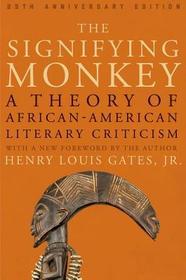
The Signifying Monkey
A Theory of African-American Literary Criticism
- Publisher's listprice GBP 19.99
-
9 025 Ft (8 595 Ft + 5% VAT)
The price is estimated because at the time of ordering we do not know what conversion rates will apply to HUF / product currency when the book arrives. In case HUF is weaker, the price increases slightly, in case HUF is stronger, the price goes lower slightly.
- Discount 10% (cc. 903 Ft off)
- Discounted price 8 122 Ft (7 736 Ft + 5% VAT)
Subcribe now and take benefit of a favourable price.
Subscribe
9 025 Ft

Availability
printed on demand
Why don't you give exact delivery time?
Delivery time is estimated on our previous experiences. We give estimations only, because we order from outside Hungary, and the delivery time mainly depends on how quickly the publisher supplies the book. Faster or slower deliveries both happen, but we do our best to supply as quickly as possible.
Product details:
- Edition number Reissued Edition
- Publisher OUP USA
- Date of Publication 7 August 2014
- ISBN 9780195136470
- Binding Paperback
- No. of pages352 pages
- Size 234x152x25 mm
- Weight 576 g
- Language English
- Illustrations 16 illustrations 0
Categories
Short description:
Henry Louis Gates, Jr.'s original, groundbreaking study explores the relationship between the African and African-American vernacular traditions and black literature, elaborating a new critical approach located within this tradition that allows the black voice to speak for itself.
MoreLong description:
Henry Louis Gates, Jr.'s original, groundbreaking study explores the relationship between the African and African-American vernacular traditions and black literature, elaborating a new critical approach located within this tradition that allows the black voice to speak for itself. Examining the ancient poetry and myths found in African, Latin American, and Caribbean culture, and particularly the Yoruba trickster figure of Esu-Elegbara and the Signifying Monkey, whose myths help articulate the black tradition's theory of its literature, Gates uncovers a unique system of interpretation and a powerful vernacular tradition that black slaves brought with them to the New World. His critical approach relies heavily on the Signifying Monkey--perhaps the most popular figure in African-American folklore--and signification and Signifyin(g). Exploring signification in black American life and literature by analyzing the transmission and revision of various signifying figures, Gates provides an extended analysis of what he calls the 'Talking Book', a central trope in early slave narratives that virtually defines the tradition of black American letters. Gates uses this critical framework to examine several major works of African-American literature--including Zora Neale Hurston's Their Eyes Were Watching God, Ralph Ellison's Invisible Man, and Ishmael Reed's Mumbo Jumbo--revealing how these works signify on the black tradition and on each other. The second volume in an enterprising trilogy on African-American literature, The Signifying Monkey--which expands the arguments of Figures in Black--makes an important contribution to literary theory, African-American literature, folklore, and literary history.
Eclectic, exciting, convincing, provocative, challenging ... Gates gives black literature room to breathe, invents interpretive frameworks that enable us to experience black writing rather than label it in terms of theme or ideology. From this perspective his book is a generous, long-awaited gift ... Like great novels that force us to view the world differently, Mr. Gates' compelling study suggests new ways of seeing.
Table of Contents:
New Preface
Introduction
Part I
1. A Myth of Origins:Esu Elegbara and the Signifying Mokey
2. The Signifying Monkey and the Language of Signifyin(g): Rhetorical Difference and the Orders of Meaning
3. Figures of Significance
Part II
4. The Trope of the Talking Book
5. Zora Neale Hurston and the Speakerly Text
6. On "The Blackness of Blackness": Ishmael Reed and a Critique of the Sign
7. Color Me Zora: Alice Walker's (Re) Writing of the Speakerly Text
New Afterward
Notes
Index

