

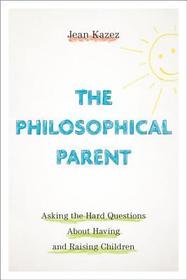
The Philosophical Parent
Asking the Hard Questions About Having and Raising Children
- Publisher's listprice GBP 29.99
-
13 540 Ft (12 895 Ft + 5% VAT)
The price is estimated because at the time of ordering we do not know what conversion rates will apply to HUF / product currency when the book arrives. In case HUF is weaker, the price increases slightly, in case HUF is stronger, the price goes lower slightly.
- Discount 10% (cc. 1 354 Ft off)
- Discounted price 12 186 Ft (11 606 Ft + 5% VAT)
Subcribe now and take benefit of a favourable price.
Subscribe
13 540 Ft

Availability
printed on demand
Why don't you give exact delivery time?
Delivery time is estimated on our previous experiences. We give estimations only, because we order from outside Hungary, and the delivery time mainly depends on how quickly the publisher supplies the book. Faster or slower deliveries both happen, but we do our best to supply as quickly as possible.
Product details:
- Publisher OUP USA
- Date of Publication 27 September 2018
- ISBN 9780190914189
- Binding Paperback
- No. of pages336 pages
- Size 142x208x20 mm
- Weight 363 g
- Language English 0
Categories
Short description:
The Philosophical Parent is a companion for parents and parents-to-be that explores the many philosophical questions that come with making and raising children. Jean Kazez explores eighteen perplexities, from the practical to the profound, arguing for a novel view of the parent-child relationship, with implications at every stage of parenthood.
MoreLong description:
Becoming parents draws us into philosophical quandaries before our children have even been born. Why do most of us want to have children? Should we make new people, despite life's travails and our crowded world? Is adoptive parenthood just the same as biological parenthood? Once children arrive, the questions start to be a mix of the profound and the practical. Should we share our lifestyle with our children, no matter how unusual? Should we vaccinate and may we circumcise? Should we encourage gender differences?
Tracing the arc of parenthood from the earliest days to the college years and beyond, Jean Kazez explores 18 questions for philosophical parents, applying the tools of philosophy and drawing on personal experience. The Philosophical Parent offers a novel account of the parent-child relationship and uses it to tackle a variety of parenting puzzles, but more than that, Kazez celebrates both having children and philosophical reflection. Her book provides a challenging but cheerful companion for thoughtful parents and parents-to-be.
It is written with beautiful clarity and precision and an enviable command of quite complex material. I know of no other summary of the non-identity problem that is so perspicuous and - importantly - sufficient to persuade those sceptical of the other-worldly character of some modern philosophy that this problem matters. This is a text free of intrusive footnotes and elaborate reconstructions of theories and arguments. The annotated bibliography at the back provides evidence enough of the considerable background reading that informs Kazez's writing. And the writing is charmingly engaging - who can resist a phrase such as 'cosmic orphanage' as an allusive description of that set of possible persons yet to be brought into existence and reared? Kazez is evidently a thoughtful, conscientious parent who has worried - but not obsessively - about what parenthood requires of her, and her broadly liberal sympathies are on display throughout.
Table of Contents:
Introduction
1. Children Come from Us What's so special about having kids?
2. Life is Good Are babies lucky to be born or just the opposite?
3. Quantity Control Must we care about population statistics?
4. Quality Control Should we mess with nature?
5. In the Beginning What's going on in there?
6. A Child is Born Is labor pain simply awful?
7. Whose Child is This? Why do biological parents have prerogatives?
8. Nobody's Child Does biology really matter?
9. Parenthood's End What's a parent for?
10. First Decisions To cut or not to cut?
11. Still Life with Child Who's going to care for the baby?
12. Boys and Girls Is it OK to prefer a girl/boy? Should parents reinforce gender?
13. The One and the Many When must I contribute to group efforts?
14. Lies, Lies, Lies Should we ever lie to children…or for them?
15. Passing on Religion Should we raise children in our own image?
16. Letting Go What should we do for our grown children?
17. Going Home What should our grown children do for us?
18. Parenthood and Meaning Does parenthood make us better off?
Acknowledgements
Annotated Bibliography

