

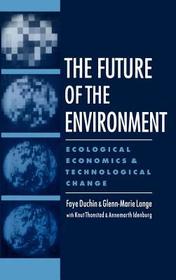
The Future of the Environment
Ecological Economics and Technological Change
- Publisher's listprice GBP 83.00
-
37 474 Ft (35 690 Ft + 5% VAT)
The price is estimated because at the time of ordering we do not know what conversion rates will apply to HUF / product currency when the book arrives. In case HUF is weaker, the price increases slightly, in case HUF is stronger, the price goes lower slightly.
- Discount 10% (cc. 3 747 Ft off)
- Discounted price 33 727 Ft (32 121 Ft + 5% VAT)
Subcribe now and take benefit of a favourable price.
Subscribe
37 474 Ft

Availability
printed on demand
Why don't you give exact delivery time?
Delivery time is estimated on our previous experiences. We give estimations only, because we order from outside Hungary, and the delivery time mainly depends on how quickly the publisher supplies the book. Faster or slower deliveries both happen, but we do our best to supply as quickly as possible.
Product details:
- Publisher OUP USA
- Date of Publication 2 March 1995
- ISBN 9780195085747
- Binding Hardback
- No. of pages240 pages
- Size 242x162x22 mm
- Weight 500 g
- Language English
- Illustrations line figures, tables 0
Categories
Short description:
This book examines the effect of technology on the environment in economic development, and argues that major changes in its use must be made in order not to degrade the environment - especially in developing countries.
MoreLong description:
One of the most important and complex problems facing both developing and industrialized nations is how to sustain economic growth without harming the environment. Faye Duchin and Glenn-Marie Lange address this issue in a practical and realistic way: through a detailed evaluation of the well-known approach to sustainable development outlined in the Brundtland Report, Our Common Future.
Taking issue with the Brundtland Report's optimistic and widely accepted assumptions, the authors show that the positive effects of recycling, increased fuel-efficiency, and other technological adjustments will not go far enough to provide for truly sustainable development in the long term. Through a new, broad-based empirical analysis, they argue that unless there are significant changes in the use of technologies, continued environmental degradation cannot be avoided. They warn that the trend of making only slight adjustments in the use of technologies, while feasible from an economic point of view for industrialized nations, will undoubtedly lead to further environmental damage.
In addition to offering a clear and unflinching look at what development is really doing to the global environment, the unique conceptual framework developed for this analysis provides an invaluable basis for analysis for the new, multidisciplinary field of ecological economics. Duchin and Lange describe how this new methodology will enable economists and policy-makers to evaluate our options for the future and choose those that most effectively reduce environmental degradation and achieve sustainable development.
A very important piece of information, which we hope will help to determine current and future socio-economic and technological choices.

