

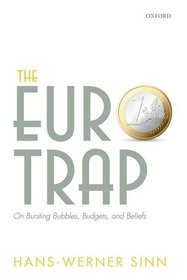
The Euro Trap
On Bursting Bubbles, Budgets, and Beliefs
- Publisher's listprice GBP 42.99
-
20 538 Ft (19 560 Ft + 5% VAT)
The price is estimated because at the time of ordering we do not know what conversion rates will apply to HUF / product currency when the book arrives. In case HUF is weaker, the price increases slightly, in case HUF is stronger, the price goes lower slightly.
- Discount 10% (cc. 2 054 Ft off)
- Discounted price 18 484 Ft (17 604 Ft + 5% VAT)
Subcribe now and take benefit of a favourable price.
Subscribe
20 538 Ft

Availability
printed on demand
Why don't you give exact delivery time?
Delivery time is estimated on our previous experiences. We give estimations only, because we order from outside Hungary, and the delivery time mainly depends on how quickly the publisher supplies the book. Faster or slower deliveries both happen, but we do our best to supply as quickly as possible.
Product details:
- Publisher OUP Oxford
- Date of Publication 31 July 2014
- ISBN 9780198702139
- Binding Hardback
- No. of pages404 pages
- Size 241x164x29 mm
- Weight 768 g
- Language English
- Illustrations 59 Figures and 5 Tables 0
Categories
Short description:
This book offers a critical assessment of the history of the euro, its crisis, and the rescue measures taken by the European Central Bank and the community of states.
MoreLong description:
This book offers a critical assessment of the history of the euro, its crisis, and the rescue measures taken by the European Central Bank and the community of states. The euro induced huge capital flows from the northern to the southern countries of the Eurozone that triggered an inflationary credit bubble in the latter, deprived them of their competitiveness, and made them vulnerable to the financial crisis that spilled over from the US in 2007 and 2008. As private capital shied away from the southern countries, the ECB helped out by providing credit from the local money-printing presses. The ECB became heavily exposed to investment risks in the process, and subsequently had to be bailed out by intergovernmental rescue operations that provided replacement credit for the ECB credit, which itself had replaced the dwindling private credit. The interventions stretched the legal strictures stipulated by the Maastricht Treaty which, in the absence of a European federal state, had granted the ECB a very limited mandate. These interventions created a path dependency that effectively made parliaments vicarious agents of the ECB's Governing Council.
This book describes what the author considers to be a dangerous political process that undermines both the market economy and democracy, without solving southern Europe's competitiveness problem. It argues that the Eurozone has to rethink its rules of conduct by limiting the role of the ECB, exiting the regime of soft budget constraints and writing off public and bank debt to help the crisis countries breathe again. At the same time, the Eurosystem should become more flexible by offering its members the option of exiting and re-entering the euro - something between the dollar and the Bretton Woods system - until it eventually turns into a federation with a strong political power centre and a uniform currency like the dollar.
This detailed, heavily footnoted book by prominent German economist Sinn (Univ. of Munich) assesses the euro and the ongoing concerns about the economies of the euro-zone countries. He provides considerable data, often on individual countries (e.g., Greece, Ireland, Spain, and Italy), and retains a clear point of view on what occurred and why.
Table of Contents:
Introduction
Wish and Reality
Bubbles in the Periphery
The Other Side of the Coin
The Competitiveness Problem
The White Knight
The European Balance-of-Payments Crisis
Current Accounts, Capital Flight, and Target Balances
Stumbling Along
Rethinking the Eurosystem

