

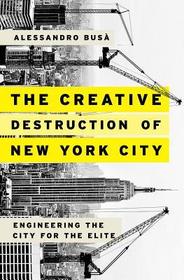
The Creative Destruction of New York City
Engineering the City for the Elite
- Publisher's listprice GBP 25.99
-
12 416 Ft (11 825 Ft + 5% VAT)
The price is estimated because at the time of ordering we do not know what conversion rates will apply to HUF / product currency when the book arrives. In case HUF is weaker, the price increases slightly, in case HUF is stronger, the price goes lower slightly.
- Discount 10% (cc. 1 242 Ft off)
- Discounted price 11 175 Ft (10 643 Ft + 5% VAT)
Subcribe now and take benefit of a favourable price.
Subscribe
12 416 Ft

Availability
Estimated delivery time: In stock at the publisher, but not at Prospero's office. Delivery time approx. 3-5 weeks.
Not in stock at Prospero.
Why don't you give exact delivery time?
Delivery time is estimated on our previous experiences. We give estimations only, because we order from outside Hungary, and the delivery time mainly depends on how quickly the publisher supplies the book. Faster or slower deliveries both happen, but we do our best to supply as quickly as possible.
Product details:
- Publisher OUP USA
- Date of Publication 14 September 2017
- ISBN 9780190610098
- Binding Hardback
- No. of pages360 pages
- Size 163x239x25 mm
- Weight 635 g
- Language English 0
Categories
Short description:
The Creative Destruction of New York City tells the story of fifteen years of shocking urban changes in New York City under the administrations of Bloomberg and de Blasio, and identifies the urban regime of city producers who are rebuilding cities like New York for a brand new global class of super-wealthy city consumers.
MoreLong description:
Bill de Blasio's campaign rhetoric centered on a tale of two cities: rich and poor New York. He promised to value the needs of poor and working-class New Yorkers alongside the elite, making government work better for all denizens of New York, not just those-the elite-who thrived during Bloomberg's tenure as mayor. But well into de Blasio's administration, many critics see the city finding myriad new ways to create profit for land owners and developers through a constant process of destruction and rebuilding. Many lauded his goals of creating more affordable housing, but, in 2015, Brooklyn was deemed the most unaffordable housing market in the United States, when viewed as a median income-to-median home cost ratio. Manhattan even with its higher median income, was the third least affordable market. Its notable new buildings include the much-maligned 432 Park Avenue, which is usually uninhabited due to the fact that most of its units are fourth residences. The old adage is becoming truer: New York is a place only for the very rich and the very poor.
In The Creative Destruction of New York City, urban scholar Alessandro Bus? tells the story of fifteen years of shocking transformations in the city, and an updated tale of two New Yorks, circa 2017. There is a gilded city of sky-high glass towers where Wall Street managers, Hollywood celebrities and Middle-Eastern billionaires live their glamorous lives or stash their offshore cash. And there is another New York, a city where even the professional middle class is one rent hike away from eviction. Despite de Blasio's rhetoric, the trajectory since Bloomberg has been remarkably consistent. A brand new global class of super-wealthy city consumers has been born, and, Bus? argues, New York's urban development is changing to suit their ostentatious consumption demands. Meanwhile, the power of city producers, those who hold all the cards in the city building game, has never been greater.
Power players in real estate, banking and finance have managed to ensure that, regardless of changes in leadership, their interests are safeguarded at City Hall. By aggressively re-zoning and re-branding neighborhoods across the board, they are producing a brand new city, a repackaged wonderland of lavish real estate targeting the elite market. The Creative Destruction of New York City is an important chronicle of both the success of the city's elite and of efforts to counter the city's march toward a glossy and exclusionary urban landscape. It is essential reading for everyone who cares about affordable housing access and, indeed, the soul of New York City.
Table of Contents:
Foreword
Introduction
Chapter 1: The New Face of Harlem's Main Street
Chapter 2: How Capital Shapes Our Cities
Chapter 3: City Producers and City Consumers
Chapter 4: City Producers and City Consumers in New York City
Chapter 5: Rezoning NYC
Chapter 6: Branding NYC
Chapter 7: The Rezoning that Almost Killed Coney Island
Chapter 8: A Different Brand of Mayor
Afterword

