

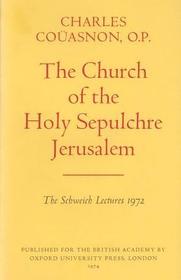
The Church of the Holy Sepulchre Jerusalem
Series: Schweich Lectures on Biblical Archaeology; 1972;
- Publisher's listprice GBP 40.00
-
19 110 Ft (18 200 Ft + 5% VAT)
The price is estimated because at the time of ordering we do not know what conversion rates will apply to HUF / product currency when the book arrives. In case HUF is weaker, the price increases slightly, in case HUF is stronger, the price goes lower slightly.
19 110 Ft

Availability
Estimated delivery time: In stock at the publisher, but not at Prospero's office. Delivery time approx. 3-5 weeks.
Not in stock at Prospero.
Why don't you give exact delivery time?
Delivery time is estimated on our previous experiences. We give estimations only, because we order from outside Hungary, and the delivery time mainly depends on how quickly the publisher supplies the book. Faster or slower deliveries both happen, but we do our best to supply as quickly as possible.
Product details:
- Publisher The British Academy
- Date of Publication 1 January 1974
- ISBN 9780197259382
- Binding Hardback
- No. of pages104 pages
- Size 254x157x5 mm
- Weight 322 g
- Language English
- Illustrations 28pp plates 0
Categories
Short description:
No one has probably had such a close knowledge of the Church of the Holy Sepulchre in Jerusalem, from foundation to roof top, as Father Coüasnon, who, among others, was instrumental in drawing up the restoration plan agreed upon in 1959 by the various churches owning different parts of the complex of buildings. In his Schweich Lectures delivered at the British Academy in 1972, Father Coüasnon describes the history of the church in detail, revealing the fresh discoveries which have enabled the site to be planned with a new authority.
Long description:
The Church of the Holy Sepulchre in Jerusalem has suffered many vicissitudes. A Constantinian foundation, it was twice destroyed and rebuilt before the Crusaders took it in hand. Respected by Saladin at his conquest, the church remained much as the Crusaders left it, until in 1808 a fire broke out and spread through the whole building. In 1927 a severe earthquake shook Jerusalem causing widespread damage to the structure, so that for forty years afterwards the southern façade was supported by steel scaffolding.
No one has probably had such a close knowledge of the church, from foundation to roof top, as Father Coüasnon, who, among others, was instrumental in drawing up the restoration plan agreed upon in 1959 by the various churches owning different parts of the complex of buildings. In his Schweich Lectures delivered at the British Academy in 1972, Father Coüasnon describes the history of the church in detail, revealing the fresh discoveries which have enabled the site to be planned with a new authority.
MoreTable of Contents:
- Historical Background
- 1: The Tomb at the time of the Apostles
- 2: The authenticity of the traditional site
- 3: The town plan of Aelia Capitolina
- 4: The discovery of the Tomb
- 5: The two construction sites
- 6: Highlights in the history of the Holy Sepulchre
- The Rotunda
- 1: The courtyard around the Tomb pre-dating the Rotunda
- 2: The courtyards to the north and west of the Rotunda
- 3: The periphery walls of the Rotunda
- 4: The interior arrangement of the Rotunda: the twelve columns of Arculf
- 5: The height of the columns and the interior dimensions
- 6: The facade of the Rotunda: the eight doors of Arculf
- 7: The form of the Rotunda
- Constantine's Basilica and Golgotha
- 1: The courtyard in fromt of the Rotunda and the rock of Calvary
- 2: The Basilica
- 3: The atrium and propylaea
- 4: The buildings around the Basilica: the Baptistry
- 5: The church of Golgotha
- The Holy Sepulchre from 1009 to the Present Day
- 1: The eleventh-century monument
- 2: The church of the Crusaders

