

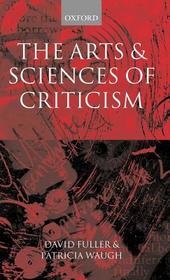
The Arts and Sciences of Criticism
- Publisher's listprice GBP 47.99
-
22 927 Ft (21 835 Ft + 5% VAT)
The price is estimated because at the time of ordering we do not know what conversion rates will apply to HUF / product currency when the book arrives. In case HUF is weaker, the price increases slightly, in case HUF is stronger, the price goes lower slightly.
- Discount 10% (cc. 2 293 Ft off)
- Discounted price 20 634 Ft (19 652 Ft + 5% VAT)
Subcribe now and take benefit of a favourable price.
Subscribe
22 927 Ft

Availability
printed on demand
Why don't you give exact delivery time?
Delivery time is estimated on our previous experiences. We give estimations only, because we order from outside Hungary, and the delivery time mainly depends on how quickly the publisher supplies the book. Faster or slower deliveries both happen, but we do our best to supply as quickly as possible.
Product details:
- Publisher OUP Oxford
- Date of Publication 17 June 1999
- ISBN 9780198186397
- Binding Hardback
- No. of pages276 pages
- Size 223x144x19 mm
- Weight 436 g
- Language English 0
Categories
Short description:
What can we expect of literature? And what should the role of criticism be? This collection reflects on developments in criticism and the different modes of knowledge that underwrite literature: a science model and its place in the university versus other ways of conceiving knowledge for which the arts have traditionally been seen as vehicles. Discussion ranges widely with contributions from leading academics as well as those outside the literary academy, including essays by the novelists Doris Lessing and David Lodge. All the essays are concerned with what literature, and therefore criticism, is or aims to be.
MoreLong description:
This collection reflects on developments in criticism which bear on a debate between different modes of knowledge: a science model and its place in the university versus other ways of conceiving knowledge for which the arts have traditionally been seen as vehicles. Discussion ranges widely with contributions from outside the literary academy, including essays by the novelists Doris Lessing and David Lodge. All the essays are concerned with what literature, and therefore criticism, is or aims to be. Several are concerned with a specifically aesthetic way of knowing, the value of which lies in its very resistance to scientific models of knowledge. The answers about how literature can resist such models, and what kinds of knowing best respond to the distinctive nature of aesthetic experience, are varied. The collection also addresses the consequences for literary criticism of the politically-driven critique which has recently undermined traditional concepts of truth and knowledge in both arts and sciences. And finally it asks whether professional criticism should be a deepened extension of the sense-making activity of ordinary intelligent reading, or whether it should be a purely objective study, analogous to other scientific forms of knowledge studied in an academic context.
finely edited and spirited collection of essays on the limitations and possibilites of literary criticism ... In these essays the author is alive and well, aestheic knowledge is distinguished from science, there is a humanistic understanding of consciousness and a notion of purpose, meaning and aesthetic delight.
Table of Contents:
Introduction
Part I: Criticism and the History and Philosophy of Science
Revising the Two Cultures Debate: Science, Literature and Value
Science, Interpretation and Criticism
Evidence-based and Evidence-free Generalisations: a Tale of Two Cultures
Science and the Self: Lacan's doctrine of the Signifier
Part II: Criticism and the Aesthetic
Poetry as Literary Criticism
Criticism and Creation
Writing Autobiography
Beneath Interpretation: Intention and the Experience of Literature
Poetry, Music and the Sacred
Part III: Criticism and the Ethical
The Aesthetic, the Cognitive and the Ethical: Criticism and Discursive Responsibility
Literature and the Crisis in the Concept of the University
The Metaphysics of Modernism: Aesthetic Myth and the Myth of the Aesthetic

